Showing posts with label san-francisco. Show all posts

Friday, August 29, 2014

Uber vs taxi wait times: non-anecdotal evidence

More on the taxis vs. Uber in San Francisco beat.

I repeat my previous assertion that, anecdotally, ">20 min" is an understatement on weekend nights, and that the decision to use only 3 buckets ("<10 min", "10-20 min", ">20 min") conceals the long tail. As in so many other applications, tail latency has a disproportionate negative effect on on user experience, and looking at even the median or mean latency is insufficient: you should measure out to 95th percentile latency at least (n.b. this is standard procedure at Google).

Monday, June 23, 2014

More on taxis

I will fully cop to the fact that my previous bitching about taxis concerned a classic San Francisco yuppie firstworldproblem but here are some more stories about how taxis in many cities serve people of all stripes exceptionally poorly.

Relatedly, I took an UberX with a friend the other night and the experience was awesome.

I might have liked the option of tipping the the driver (via the app, after you get out of the car), but UberX doesn't allow that. On the other hand, maybe tipping would establish a social norm for companies like Uber to underpay their drivers with the expectation of tips? I really like traveling abroad in countries that don't have a tipping culture; it seems more rational and arguably in the long run leaves labor in a better position since their compensation is assured by contractual terms rather than manners. So maybe it's great that Uber doesn't have tipping, only reviews.

Wednesday, June 18, 2014

Uber and taxis in San Francisco

Uber is a national story now, but this post from a former colleague reminded me of a little fact about Uber's origins that many observers outside of San Francisco probably don't know.

Before Uber existed, San Francisco taxicabs were extremely unreliable. On busy nights, you would commonly call a cab dispatching company on your cell phone, talk to a dispatcher who promised that a cab would arrive, wait half an hour or more, and still have no cab show up. This only has to happen a couple of times, on a chilly San Francisco Saturday night while your date stands on the street shivering in her dress and heels, before you start saying to yourself, "Fuck all taxicab companies, forever."

Conversely, I speculate that it was not uncommon for cab drivers to receive a call, only to have the passengers disappear, since they'd grabbed another cab that happened by sooner. In fact, once I concluded that taxi drivers were as likely to flake out on me as not, I started doing this myself. What else could you do?

In other words, game-theoretically, taxicabs and passengers were stuck in a low-trust equilibrium. Passengers could not rely on cabs, so they would grab any cab they could, even if they'd called one. Cabs could not rely on passengers, so they would pick up any fare that looked promising, even if they had been dispatched. A taxi company could have disrupted this equilibrium by offering reliable service and building a brand name as such. None of them did. Much like your local cable company, they were collectively content to sit on their government-protected oligopoly and treat customers like garbage.

(Notice that passengers can't disrupt this equilibrium: there's no equivalent "union of passengers" to which a reputation for reliability could be attached.)

The most important thing about Uber, at least initially, was not that you called it with a handy smartphone app, or that Uber cars were fancy black limos, nor even that they always accepted credit cards.[0] It was simpler than that: Uber cars came when you called. Uber achieves this result through a variety of means, but the most obvious is simply holding individual drivers accountable for every ride.

Therefore, at least in San Francisco, the whining of taxi companies exposed to competition from Uber and Lyft is the whining of any industry that serves its customers badly, and then is exposed to superior competition that serves its customers well.

Uber's initial success in San Francisco was a key stepping stone in their rise to national prominence. One wonders whether Uber would exist today if even a single SF cab company had served customers reliably.

[0] p.s. The credit card thing. Every SF taxi rider has had this happen: the driver has the credit card reader in the car, staring you in the face, but the driver says: "Sorry, it's not working." Now, if this happened once in a while, you might believe it. But it happens every single time. Is it really the case that every single credit card reader in the SF taxicab fleet is out of order 100% of the time despite a good-faith effort to keep them operational? Or is it much more likely that the driver is trying to cheat on his taxes, which is made easier if he forces all his customers to tip him in cash? Or else the taxi company is cheating on its obligations to its drivers by keeping tips paid on credit cards for itself? And now this confederacy of cheats wants the government to protect them from competition? Do you feel sympathy for this band of cynical hypocrites?

Sunday, January 25, 2009

Urban pranksterism you can believe in

By way of explaining my previous post to people not resident in the Bay Area, LaughingSquid brings us a video and press release allegedly from those responsible. If you prefer the work of Real Journalists then you may also peruse this Google News cluster, of which the SFGate blog is probably the best representative.

Incidentally, I'd bet good money that there will someday be an officially recognized Barack Obama St. in San Francisco.

Tuesday, January 20, 2009

Corner of Bush & Buchanan, San Francisco, 6:35 a.m.

Apologies for the low light; it was an early morning today.

Friday, October 27, 2006

To the Critical Asses who interrupted my commute today:

My shuttle home today was halted, idling in traffic and burning fuel needlessly, for over 20 minutes today because of you self-righteous assholes. Congratulations, fucktards, you just made an enemy!

Streets are mixed-use facilities. In normal conditions, cars, bikes, pedestrians, rollerbladers, Segway riders, and all kinds of other uses share the public space. Critical Mass doesn't inspire people to respect the streets; it comes across as a bovine herd out to spitefully annoy others. The moral equivalent of Critical Mass would be a bunch of car drivers parking on the sidewalk to make a point about obnoxious pedestrians. Do you think such an action would cause pedestrians to reform their behavior? What makes you think your gesture works any better?

And I love how this movement's so big in San Francisco. Because there's such powerful opposition to mass transit, renewable and alternative fuel sources, and liberal do-goodery in general here. That point really needs to be made in the most confrontational way in this district, doesn't it. Why don't you take your shit to Los Angeles, or better yet to Bumfuck, Utah or someplace where everybody drives all the time and votes Republican? Oh, that's right --- your stunt only works here because San Francisco is already really dense, and therefore energy-efficient.

So, I got off the shuttle and actually laid myself down in the path of the bicyclists at Larkin and Golden Gate... for about thirty seconds, before I concluded that nobody else was going to join me, and therefore my gesture was futile. Resigned to this folly, I stood up and walked home.

Although, now that I think about it, maybe I should have stayed lying on the street longer. The moral status of a pedestrian one-ups that of a bicyclist, and if I stayed long enough then maybe other people would have gotten out of their cars and laid down too.

Maybe. Next year.

I suspect this post will make me some enemies. Well, it's been a while since I wrote something flat-out obnoxious. Back to form once again.

Friday, October 20, 2006

Friday cat blogging

Warning: ...ah, hell, if you can't guess from the title, your time deserves to be wasted.

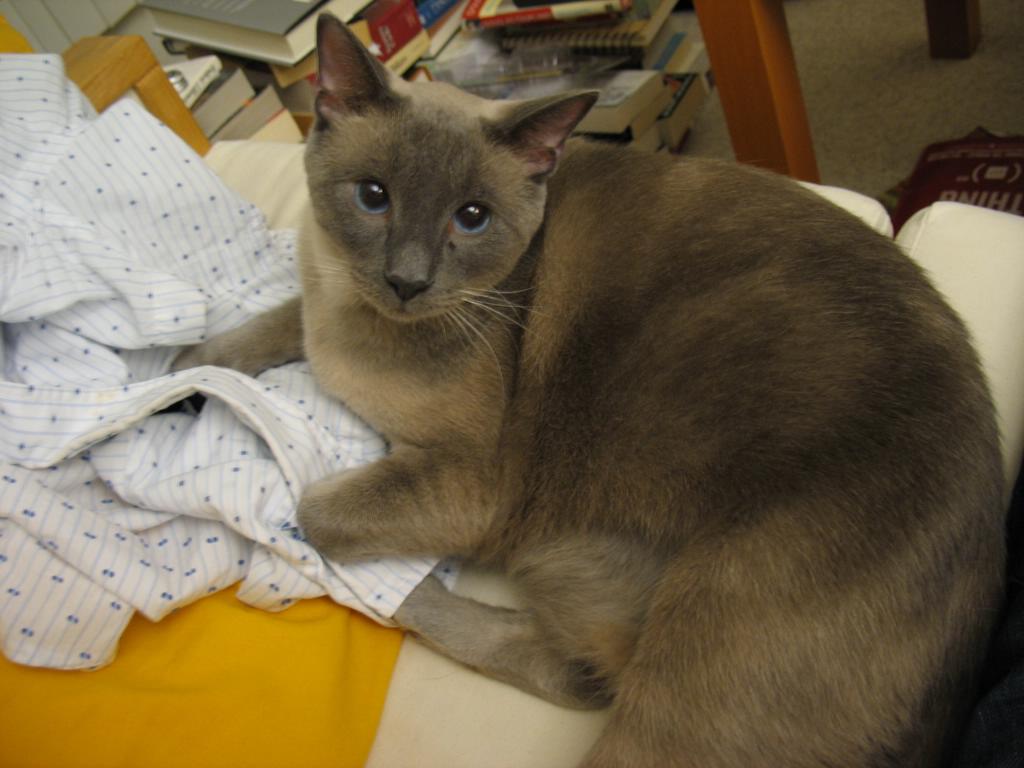
A nervous but resilient feline. The SF SPCA got him from San Francisco City Animal Care & Control; who knows where he was before that, although his behavior indicates that he once had an attentive human home. The SPCA's veterinary records state that upon arriving at the SPCA, he suffered from extreme fear-related anorexia, leading to liver disease, and he had to be placed on a feeding tube. A few weeks later he was up and about again, fully recovered. When I found him at Maddies Adoption Center a couple of months later, Manny climbed onto my lap.

Peace never lasts. My nefarious plan for feline adoption necessarily entailed having an SPCA volunteer pack his yowling, hissing, miserable ass into a cardboard box. Evidently not one to take mistreatment lying down, he clawed his way out of the box during the ride home.

He spent the rest of the ride climbing around the car in panic, hyperventilating and hissing. At this point, Bay Area readers should imagine the drive from the Inner Mission to just north of Japantown, and the jostling it implies.

Cat adoption guidelines tell you to have a quiet, isolated room prepared with cat necessities. They're not kidding around. I set him down in the bathroom, and for the rest of the day he stayed there, retreating under the sink or behind the toilet whenever the door opened. My chief bonding tactic was to lie down on the bathroom floor and take naps. Sleep evidently rendered me sufficiently harmless that he was willing to come over and sniff at me periodically. (Maybe I should try this with women.)

Anyway, eliding some details, a dozen days later and he's out and about, accepting my food and affection. Unexpected noises or fast movements continue to make him flighty. Still, the mongrel cat has come home.

[Manny in the sun]