Showing posts with label internet. Show all posts

Saturday, February 06, 2021

Freedom of speech, and how to reason productively about it

Most people develop opinions about how speech should be restricted via a priori reasoning from abstract principles, often absorbed from primary school civics lessons or other tribal recitations (for example, these days, social media memes).

But in a consequentialist, utilitarian framework, how discourse should be regulated depends on several empirical questions:

  • Speech is a physical reality; the speech that occurs in a given medium can be measured.
  • The beliefs, behaviors, and harms that a system of speech engenders are also physical realities, and also to some extent measurable.
  • The effects of a given mode of speech regulation are also measurable realities.

To put it another way, media are systems with particular mechanics, like games; Twitter is a different game, for example, than Reddit, and both are different from digital journalism or cable news. The mechanics of a medium drive higher-level emergent dynamics, which (for nontrivial systems) can only be studied empirically. The proper instruments of study cannot be drawn from the toolkit of a priori philosophy alone; they require the methods of science and engineering: experimentation, simulation, modeling, comparison of modeling predictions against empirical data.

I posit that any practicing computer game designer could easily design a "speech game" where bad speech totally drives out good. In fact, this would be so easy that the only design challenge would be making it fun enough that anyone would want to play. As a player of that game, you would be a fool to embrace the strategy that "the remedy to be applied is more speech" (quoting Brandeis); you would simply be crushed; your adversaries would laugh at your naivete. I hope this idea seems obvious to you. But are you certain that we aren't all playing such a game in one or more spheres of real life?

It is sad to me that so much effort is spent (wasted!) arguing in totally unproductive circles about some aspect of free speech ("censorship", "cancel culture", "deplatforming", etc.), and so little effort is spent understanding empirically the connection between mechanics and dynamics.

Tuesday, March 20, 2018

How resistant is Bitcoin to government regulation?

Excavated from the drafts folder. I composed this in December 2017 (although I can't prove it) and I am publishing it now because recent news has rendered the postscript timely.

Bitcoin depends on the following three types of infrastructure:

  • Semiconductor fabrication plants.
  • Electric power plants.
  • Transoceanic fiber-optic Internet cables.

It depends on the first two of these to an unusual extent; the third simply comes along for the ride because Bitcoin is a global Internet-connected system.

You can't access these things, or the stuff that comes out of them, when governments really don't want you to, because they are big, expensive works of physical infrastructure. A government, or coalition of governments, with sufficient motivation and resources could introduce regulation upstream or downstream of any of these choke points that simply makes further Bitcoin mining non-viable.

"The Internet interprets censorship as damage, and routes around it" is true only up to a point. It is instructive to compare Bitcoin with child porn, a category of online activity that most governments are already highly motivated to stop. Governments have mostly succeeded in eliminating it from the non-darknet parts of the Internet; even sites like 4chan, which revel in their own transgressiveness, aggressively police child porn, because these sites run on servers that sit in datacenters in the physical world that are governed by laws just like everything else. Those servers are hooked up to the power grid and connected to the Internet by physical wires that belong to some utility. To maintain these connections, money changes hands, and a paper trail is generated that ultimately leads to the server operators. If you decide to be a badass rebel and distribute child porn under these conditions, you are looking forward to jail time.

It is true that child porn exchange still occurs online, but it occurs mostly on obscure systems that are specifically designed to be censorship-resistant at the expense of widespread availability. Bitcoin could be shut down or marginalized just as easily (where "marginalized" simply means that it is used as a transaction processing system only in highly unusual circumstances, rather than as a pillar of the economy).

In fact, it could be shut down much more easily. The resource cost to produce and distribute child pornography is nearly fixed: the size of a collection of digital imagery is essentially constant, and can be produced and distributed with extremely modest equipment. Basically, individual criminals can sustain a cottage industry indefinitely. By contrast, the exponentially increasing computational power demands of Bitcoin make it particularly vulnerable to regulation. If you cannot get your hands on an ever-increasing supply of semiconductor chips and electricity, you cannot mine Bitcoin, at least not at the scale that today's largest miners operate. Bitcoin mining is not a cottage industry; it is a large-scale industrial process, with datacenters as the factories. Large capital equipment is inherently easy to regulate. And replacing all of today's gigantic mining operators with small-scale, individual miners suffers from economic and engineering problems similar to those that you'd confront if you tried to replace a Google datacenter with ten million mobile phones (let alone trying to do that while dodging mining regulations).

Bitcoin has not been regulated because governments mostly do not care enough to regulate it (yet). The starry-eyed anarchist fever dreams of the most anti-statist libertarian early Bitcoin proponents were always total fantasies. If Bitcoin does not fail completely, then either it will be tamed into just another boring part of the existing world financial system, or else governments will wake up and cripple it.


p.s. Incidentally, since it is possible to encode data on the Bitcoin blockchain, an attacker with sufficient motivation and resources could save an instance of child pornography on the blockchain. Since every node maintains a copy of the entire blockchain, and Bitcoin lacks the ability to erase transactions, the entire Bitcoin network would be transformed at a single stroke into a child porn distribution system, rendering all Bitcoin node operators criminals. This might cost an incredible amount of money — millions of dollars to stash a single image of a few KB — but once done, it would irrevocably taint Bitcoin forever. This is an aspect of Bitcoin that is obvious on inspection, yet almost never discussed.

p.p.s. It happened.


This post closed to comments because Bitcoin attracts an unusually high ratio of vocal kooks.

Monday, December 04, 2017

Two ways ISPs can do content-based filtering of encrypted traffic

Vaguely a propos of the revived net neutrality debate, a while back I saw someone on Twitter claim that it is technically not possible for ISPs to do content-based (as opposed to destination-based) filtering of SSL traffic. This statement seems initially plausible, but is false. I can think of two technical mechanisms to do content-based filtering.

First, it is possible to identify encrypted content via traffic analysis. ISPs could compile a database of traffic signatures which they wish to throttle (e.g., for videos that are available from their own video streaming services) and throttle any traffic matching that signature.

Second, ISPs can require that users add a trusted SSL root cert owned by the ISP, thus allowing the ISP to man-in-the-middle all SSL traffic. Obviously, content-based filtering then becomes trivial.

You might object that this second measure would be unacceptably onerous, and would be rejected by the market. In the near future, a middle-class American family of four may own ten or twenty Internet-connected devices, running a half-dozen operating systems, and demanding that users install a root cert on all of them would cause unbelievable inconvenience and outcry. This might be true, but without even trying very hard I can think of numerous ways that ISPs could try to acclimate users to this bitter pill:

  • Of course, the software package would be named something relatively innocuous, like "Comcast Internet Security Accelerator" or some such nonsense.
  • The MITM cert might only be required for devices that wish to access the "fast lane" — in other words, the ISP would simply throttle any SSL connection that it does not MITM. All the household's devices would be functional even if you didn't jump through this hoop, but the ones that need the fastest connections — say, the PC that streams HD VR video — would require the MITM cert installation.
  • The ISP could distribute web browsers and other apps that embed the trusted cert — for example, Comcast could provide a custom build of Chromium — and require their use for the "fast lane". Again, you wouldn't need this app for casual web browsing, only for sites that are sensitive to speed.
  • ISPs could strike distribution deals with mobile carriers to install root certs on phones. The most obnoxious way to do this would be to ship the phone's ROM with the MITM cert baked in; this would probably cause massive outcry, akin to the eDellRoot debacle. A sneakier way to do it would be to ship a carrier-branded app that has the ability to update the trusted cert store (by itself this is arguably innocuous), along with an ISP-branded app that (a) nags the user for consent when it detects that the phone is on the ISP's network, something like "Welcome to Comcast! Do you want to enable Comcast Fast Lane[TM]?", and (b) when the user "consents", installs the MITM root cert by delegating to the carrier's app.
  • ISPs could embed a web browser connected to a virtualized display in the set-top box. The set-top box, of course, would already trust the MITM cert. Then, instead of browsing directly to https://www.youtube.com/ or whatever, you would first browse to http://xfinity.local/, which would present you with a web app that is itself a browser running via remote desktop protocol. Then you would type https://www.youtube.com/ into the address bar of this web browser. The ISP could even "helpfully" set up its DNS to perform this redirection automatically (if you type youtube.com without the https).

These are just the ideas that occur to me in about twenty minutes of thinking. If these seem farfetched to you, there may be other ways to boil this frog. Companies can be rather creative when there are billions of dollars of rents to be extracted. The result does not have to be low-cost or seamless for the user; local broadband ISPs in the United States are subject to practically no competition and whatever they implement just has to be marginally less painful than waiting for your content to download over the cellular network.

Thursday, September 18, 2014

US ISPs do not deserve much credit for increasing broadband speeds

Disclaimer: I worked for Google from 2006-2013, although not on Fiber.

Towards the end of this Twitter thread sparked by Timothy B. Lee, a commenter writes (by way of defending US ISPs):

Internet speeds have increased 1500% in ten years. 250k Wi-Fi hotspots are now available. That's progress.

When I read this, I just thought, this is such bullshit. Taking it apart with sufficiently satisfying thoroughness requires more than 140 characters, so I'm going to say it here.

US ISPs are riding the wave of technological progress. Giving them credit for the wave is evidence of cluelessness so extreme as to strongly suggest intellectual dishonesty.

First, crediting ISPs for the spread of wireless hotspots is especially egregious: it's a bit like giving them credit for Moore's Law. Even if ISPs had completely failed to increase speeds beyond dial-up, people would still want local networks without the hassle of Ethernet cables. The development and spread of wireless technology was not driven by ISPs. In fact, in some ways the opposite is true, as many ISPs retained official policies against running an open wireless hotspot (or even connecting multiple devices via NAT!) long after broadband became widely available.

Second, as for a 15x improvement in ten years[0]: that might sound impressive to some people, but all I can think is that ten years equals nearly seven doublings of Moore's Law and 27 = 128. Network speed doesn't track transistor density exactly, but computing technology is full of exponential curves like this (storage density, for example, doubles even faster than Moore's Law). To anyone with a clue about computing technology, 15x in 10 years obviously sounds somewhere between mediocre and lousy. In fact, Nielsen's Law predicts compound improvement of 57x over 10 years, or nearly 4x the observed improvement claimed by Dietz.[1] When Dietz calls out 15x improvement as a talking point in ISPs' favor, he is trying to rhetorically exploit an information asymmetry, namely his audience's presumed ignorance of exponential curves in computing technology.

Therefore, the reality is that US ISPs are badly managed technological laggards, just like everyone thinks.

In fact, the pace at which ISPs have taken up technological innovation is so bad that an entrant from another industry was able to enter the market and, without even trying very hard, spank the incumbents so thoroughly that it became a national embarrassment.

Google does so many things so well that you may not even be properly surprised by this fact. Let me try to give you a visceral feel for how anomalous Google Fiber is. Consider what happened when Google entered a market where its major competitor really was pushing innovation to the limit: consider Android. Google had to dedicate hundreds of its best and hardest-working engineers to the project and enlist the support of essentially every other company in the industry, and after eight hard-fought years, the best it can show for its efforts is rough technological parity with Apple.

Or, to take an example where Google was the defender, consider what happened when Microsoft decided to enter the search engine market. Again, this is a market where the strongest competitor really was pushing innovation to the limit. Billions of dollars and millions of engineer-hours later, Bing's search quality is still slightly worse than Google's.

I don't know the head count for Google Fiber (and even if I did, it would be covered by my NDA) but I will venture a strong guess that its engineering head count is far less than Android's, like at least an order of magnitude. In Google's product portfolio, judging by the scale of investment and strategic value, Google Fiber is basically a hobby, one that Google would never even have tried if US ISPs were remotely as good at their jobs as, say, ISPs in South Korea. And yet, technologically, Google Fiber simply outclassed these incumbents, who are supposedly competing and innovating furiously to earn your dollar.[2]

Imagine you had a friend who claimed to be training super-hard at tennis. But whenever you're at the courts, you see them go out to the court, set up the tennis ball machine, and swat lethargically at balls for about ten minutes, after which they sit down to sip an energy drink and diddle around on their phone. Then, one day, your niece, who's in reasonably good shape but has never picked up a tennis racket in her life, drops by, and she walks onto the court and crushes your friend in straight sets without breaking a sweat. You might reasonably question whether your friend was really training as hard as they claim.

In short, lauding the big US ISPs for their piddling achievements is the soft bigotry of low expectations.

But don't worry, ISPs, America isn't giving up on you. We believe that if you're subjected to the right mixture of tough love, including the right kinds of competition and regulation, you're capable of achieving just as much as Google Fiber did. Or, at a minimum, we believe that the ISP market is capable of achieving that. In the meantime, we'll try hard to ignore the risible bullshit of telecom hacks who claim that you're doing well enough.


[0] Engineers generally use multiples rather than percentages to describe improvements of this magnitude. Dietz's use of "increased 1500%" rather than 15x is a classic PR hack's way of making modestly sized numbers seem gigantic.

[1] Nielsen's predictions are fitted to observations, but those observations are for "high-end users". Dietz's number, which presumably describes mean or median users, reveals how poorly ISPs have done at making high-speed internet affordable despite the march of technology. Note that we do not see this failure in other, more competitive areas of computing technology: Intel's mid-range notebook-class processors follow Moore's Law just as well as its high-end server chips.

[2] This paragraph contains a logical honeypot for telecom hacks, who are likely to see an argument that they think they can debunk, but which they can only debunk by resorting to utter bullshit, which they will promptly be called upon. See if you can spot it.

Saturday, May 25, 2013

Ars on the YouTube-on-Windows-Phone fracas

Disclaimer: I used to work for Google, although not on YouTube. This post reflects only my personal opinions.

So many crocodile tears from Microsoft, and a shallow, silly writeup from Peter Bright, who is reliably pro-Microsoft but lately has been treading perilously close to shill territory.

Please, imagine how Microsoft would behave (indeed, has behaved in the past) were the shoe on the other foot. Imagine that any Microsoft competitor implemented an app for their platform which allowed Zune or Xbox content to be streamed in full fidelity outside of Microsoft's control.

Bright's analysis of the current behavior of the YouTube mobile site is neither here nor there. An app operating outside Google's control cannot be responsive to future changes Google makes to the YouTube user experience. Perhaps Bright has never heard of building a compelling product first, and profitably monetizing it later — also known as the business strategy of every successful consumer Internet service?

Now, leaving aside what Microsoft would do, or what makes business sense for Google, what policy is in keeping with the spirit of the Internet? The Internet is an internetwork — a network of networks — and historically it has been considered impolite to direct significant load to other people's networks without some form of reciprocal exchange, whether that's money, peering, or some other resource. Streaming videos off someone's service in your app is like hotlinking images off someone's web server in your web page, only a thousand times more bandwidth-intensive. (Since streaming video is more complex than HTTP-over-TCP, it's also greedier with non-bandwidth computational resources too.) Google gives away so much stuff gratis that now people apparently expect them to give away everything forever. But unilaterally giving away everything forever has never been a sustainable basis for internetworking.

Microsoft knows this perfectly well; as a smart man once said in a different context: "Who can afford to do professional work for nothing?"

Saturday, March 30, 2013

The web's original sin, and its possible redemption

Anil Dash made a good point last December, but he also missed something. The rot was there from the beginning. The original architectural sin of the Web was that, in the name of security, we made web browsers unable to communicate with each other directly. This made browsers completely dependent on server intermediaries, which inevitably centralizes power in the hands of those who can afford to run servers. Shortly thereafter, web browsers crowded out all other Internet client software, and that was all she wrote.

This was not the original design of the Internet. The Internet is an end-to-end system, not an end-to-middleman-to-end system. There is no fundamental reason that the software you run on your personal devices must be neutered so that it can't talk directly to other personal devices.

So, the current state of the Internet could be a temporary condition. Eventually, clients might regain the ability to open socket connections to each other directly, with discovery mediated by an open distributed protocol. Servers will still be important, but it will become possible again to write peer-to-peer protocols, and to distribute peer-to-peer client software that (unlike, say, Usenet nodes) has true mass-user accessibility and appeal.

Think of it this way. It is completely infeasible for Facebook to run its massive server farm without demanding some toll. But it is probably feasible for you to share status updates and pictures with the people you personally know, using only the spare computing power and connectivity that you all collectively own. You don't need a 1000-CPU-hour MapReduce to share baby pictures with your extended family. You need blob storage, an email-like store-and-forward messaging protocol, and a pool of hosts that's available and connected enough to distribute, say, 100 MB of data per person per week. If you're a middle-class citizen of the First World, there's an excellent chance that you and your social circle own enough computing resources to support this infrastructure already — provided those resources could be utilized properly.

Thus the most interesting thing about WebRTC is not even the real-time communication it enables (although that's pretty interesting!). WebRTC is the first step towards enabling users to send nontrivial quantities of bits directly to each other, traversing through common firewall setups, without a server intermediary and without any native client software other than a web browser.

However, WebRTC is only the first crack in the wall. Fully cutting clients loose from the server layer will be challenging. Peer-to-peer web apps will have to operate in an intermittently disconnected state, and serve content to each other reliably without the crutch of a reliable web host paid for by somebody else's money. This is a challenging computer science problem, involving aspects of system and protocol design, software engineering, and human computer interaction.

It will also be a challenging business problem: how do you convince people to use this application rather than the ones they are already used to? Facebook works well enough, if you squint and ignore confidentiality, transparency, and control with respect to your personal data. And disregarding hardware and networking costs, how does the software development itself get funded? Eben Moglen is an interesting thinker, and it seems true that when you spin the planet, software flows through the network, but I am not convinced the current induced thereby is strong enough to satisfy all our software needs.

But if we are truly to regain "the web we lost", we may have to hack around the fundamental economics of the web that replaced it.

Saturday, January 08, 2011

Sexual desire, authenticity, and Internet business models

Among the many errors in N. Vargas-Cooper's Atlantic article this month on Internet porn, one stands out as the major fallacy. The article's entire argument seems to rest on the assumption that Internet porn reflects a more authentic view of human desire than other forms of cultural production. But the prevalence of low-budget amateur porn on the Internet reflects less on the sexual stimulation that people most fervently desire than on the economic reality that it's vastly easier to build an Internet business on crowdsourced amateur porn than on any other kind of porn.*

To conclude, from the consumption of bad porn, that everyone prefers bad porn when better porn can ostensibly be had if one looks harder, is roughly like deducing from the success of McDonald's that everybody prefers Big Macs to every other type of food. Again this is a question of costs, not authenticity. Sexual desire, like hunger, is an extraordinarily robust urge and can be stimulated (and even, to some extent, satisfied) by relatively low-quality fare. Therefore, people settle. If I offered you a free dinner at McDonald's or a free dinner at French Laundry, you know which you'd pick. And yet McDonald's is a much larger business, for reasons that have nothing to do with McDonald's satisfying a more authentic or deeper hunger.

If you think I'm comparing apples and oranges with McDonald's and French Laundry, substitute In-N-Out for the latter and the answer remains the same. Even when you want a burger, you want a good one; but sometimes you settle for less, because it's cheaper or more convenient.

The analogy becomes even better if you imagine that hamburgers were culturally marginalized and frequently outlawed, such that many people were embarrassed to admit in public that they liked a good burger. Such a social and legal environment would make it hard to build a business around providing high-quality burgers, and In-N-Out or other good burger places would not exist. And cultural critics would conclude that there was some inherent property of human hunger that led us to prefer crappy burgers.

Which is why Vargas-Cooper leaps from a particular configuration of economic incentives, in a particular technological and social context, to a ridiculously broad claim about the ultimate nature of human desire.


*The proliferation of highly specialized niche porn is also a consequence of Internet economics, albeit for different reasons, which I leave as an exercise to the reader.

Thursday, May 06, 2010

On internationalized TLDs (a contrarian opinion)

The Timberites rejoice. I'm obviously revealing my North America-centric roots but I think that this is a huge amount of cost for insufficient benefit.

Great civilizations leave their stamp on the conventions of world culture. The Romans gave us their calendar; the Indians gave us the modern numbering system; the Italians gave us terms and symbols used throughout the Western world in musical notation (piano, fortissimo, crescendo, ...). The global recognizability of these signifiers is part of what makes them useful.

In the modern era, American culture predominates in computing. In practically every programming language, English words like begin, define and integer (or abbreviations thereof) have special meanings understood by every programmer in the world.

With respect to TLDs, there are two alternatives before us. Alternative one is to make everyone in the world simply learn to use ASCII TLDs. Alternative two is to make everyone in the world learn to use, or at least recognize, TLDs in every Unicode script. Alternative one is actually the simpler alternative, even for non-English speakers.

Imagine if numbers were subject to the politics of modern i18n. We would have the modern positional decimal numeric system, but also the Roman numeral system, and the Babylonian numeral system, and so on, and nobody would ever have asked anyone to standardize on any of them. After all, we have to be sensitive to the local numeric culture of the Romans!

It's not like I'm saying people should communicate in English all the time. I'm only saying that people learn to type and to recognize ASCII TLDs. This is a relatively limited set of special-purpose identifiers. There are only about an order of magnitude more ccTLDs than months in the year or decimal digits. And I would claim that it's useful for everyone in the world to recognize that, say, .uk and .com look like the end of a domain name, whereas .foobar123 does not. Pop quiz: which one of the following is a new Arabic ccTLD, مص or مصام? The reason you can't recognize it is not just that you're an English speaker — people who only speak Mandarin or Spanish or Russian are in exactly the same boat as you. And when ICANN unveils the Chinese Simplified or Cyrillic or Bengali TLD scripts, Arabic speakers in turn won't be able to make heads or tails out of those.

But, whatever, my opinion's on the losing side of history, so it's almost pointless to express it. I just thought I'd get it out there that there was a real benefit to, and precedents for, the status quo where a convention originating in one culture diffuses and becomes universal.

Friday, July 03, 2009

On "listserv"

Hypothesis: usage of the word "listserv" to mean "mailing list" generically is a shibboleth for non-technical Internet users of a certain age.

LISTSERV was the first mailing list management software, so you'd think that everybody who used the Internet before 1997 or so would call mailing lists "listservs". However, I don't think I've ever heard a programmer use the term "listserv" in the generic sense — at least not since the 90's, when LISTSERV itself was still in widespread use. Even back then, I think programmers and sysadmins mostly restricted its usage to mailing lists managed by LISTSERV specifically (as opposed to majordomo, lyris, mailman, or a plain sendmail alias).

(Speculation as to the reason for this distinction: non-technical users have a greater tendency to conflate general classes of software or protocols with specific instances of them. Example: the belief that a blue "e" is the icon for the Internet.)

Conversely, of course, kids who started using the Internet after web-based social software supplanted email and Usenet obviously don't even know what a "listserv" is. Unless/until they start working with some old fogies who use the term, I suppose.

Thursday, May 14, 2009

On URL redirectors

Back in the day, the address resolution layer of the Internet was DNS. DNS was an open, unified, distributed, redundant, highly-engineered address resolution mechanism which hid opaque identifiers like 209.131.36.158 under the hood of nice human-readable names like www.yahoo.com. Now we have a fragmented pile of proprietary, centralized, hacked-together address resolution mechanisms which replace a nice URL like freedom-to-tinker.com/blog/felten/modest-proposal-three-strikes-print with the opaque string bit.ly/4p3vL. Progress!

Saturday, February 14, 2009

C. Shirky vs. W. Isaacson on small payments and newspapers

Clay Shirky finally has a weblog, and his first post "Why Small Payments Won't Save Publishers" is, like everything else he writes, worthy of your attention (via delicious/cshalizi). Not much new here if you've read his previous critiques of micropayments, but worth reviewing nonetheless in light of recent noise w.r.t. funding news publishers via small payments. I have a couple of (extended clumps of) remarks...

1.

First, Shirky writes:

Faith in salvation from small payments all but requires the adherent to ignore the past, whether existing critiques (e.g. Szabo 1996; Shirky 2000, 2003; Odlyzko 2003) or previous failures. Isaacson’s recent Time magazine cover story on micropayments, How to Save Your Newspaper, a classic of the form, recapitulates the argument put forward by Scott McCloud in his 2003 Misunderstanding Micropayments. That McCloud advanced the same argument that Isaacson does, and that the small payment system McCloud was proselytizing for failed exactly as predicted, seems not to have troubled Isaacson much, even though he offers no argument different from McCloud’s.

It's worth reading the above-linked critiques by Szabo, Shirky, and Odlyzko, and then Isaacson's article, to realize just how terrible the latter is. It goes on a jaunt through the history of paid content, including AOL and CompuServe and (no kidding) Ted Nelson's Xanadu system and a half-dozen failed micropayment startups, and ends up with the conclusion that this time, small payments just might work!0 Isaacson breezily dismiss criticism of small-payment systems as follows:

Many tracts and blog entries have been written about how the concept can't work because of bad tech or mental transaction costs.

But things have changed.

This is literally the article's only attempt to engage the logical arguments of small-payment critics. He gives no description of the actual "bad tech" or "mental transaction costs", and he does not even seem aware that critics like Odlyzko have discussed considerably more than the technological shortcomings and transaction costs of particular payment systems.

And what exactly has changed, according to Isaacson?

"With newspapers entering bankruptcy even as their audience grows, the threat is not just to the companies that own them, but also to the news itself," wrote the savvy New York Times columnist David Carr last month in a column endorsing the idea of paid content. This creates a necessity that ought to be the mother of invention. In addition, our two most creative digital innovators have shown that a pay-per-drink model can work when it's made easy enough: Steve Jobs got music consumers (of all people) comfortable with the concept of paying 99 cents for a tune instead of Napsterizing an entire industry, and Jeff Bezos with his Kindle showed that consumers would buy electronic versions of books, magazines and newspapers if purchases could be done simply.

In other words:

  1. "Newspapers are more desperate than anyone's ever been, so it's just gotta work!" (By the same logic, if you've never gotten laid, an Olympian athlete/particle physicist/supermodel with an extraordinarily dextrous tongue will surely show up at your doorstep tonight with a bouquet of flowers and a bottle of wine.)
  2. "By generalizing from services that run on proprietary vertically-integrated hardware-software-service stacks, we can predict the success of small-payment systems for the Internet!" (Isaacson makes this same error when he cites text messaging elsewhere in the article.)

So, Isaacson's article displays objectively shoddy analytical reasoning. Furthermore, by failing even to outline the arguments of small-payment critics, he leaves his readers in the dark about an important aspect of his subject (duty to inform be damned). And to top this stupidity sundae with a cherry of irony, this terrible article about how to save journalism was just published on the cover of one of the nation's leading newsweeklies, in a week when Congress is passing a $800 billion economic stimulus package with huge implications for the national and world economy.

Why did Time's editors choose to run this article, rather than, for example, an article by Shirky or Odlyzko or any number of people who would write something more clueful? I hypothesize two reasons. First, Time's editors themselves do not have a clue, and also do not have any problem publishing articles on a subject they have no clue about. Second, look at the author blurb at the bottom of the article (emphasis mine):

Isaacson, a former managing editor of TIME, is president and CEO of the Aspen Institute and author, most recently, of Einstein: His Life and Universe..

When you're a member of the club, your buddies will publish any old crap you write; better you than some stupid professor nobody knows. We've seen this before.

I mentioned irony earlier. Isaacson has filigreed the irony with extraordinary precision. His article is inferior to material produced for free online by people who draw their paychecks from other sources (Shirky and Odlyzko are both professors who also work(ed) in the private technology sector). Furthermore, it is inferior as a direct consequence of structural weaknesses of traditional magazines. Despite its inferior quality, it presumes its own superior status by ignoring or dismissing contributions to the discussion which occurred outside of traditional "journalistic" media. Finally, taking that superiority as a given, it argues, poorly, that people ought to pay money for products like itself, because (quoting Bill Gates) nobody can "afford to do professional work for nothing".

In short, Isaacson's article not only fails to make its case, it actively undermines its own case while doing so.

2.

Second, Shirky writes:

Another strategy among the faithful [small-payments-advocates] is to extrapolate from systems that do rely on small payments: iTunes, ringtone sales, or sales of digital goods in environments such as Cyworld. (This is the idea explored by David Carr in Let’s Invent an iTunes for News.) The lesson of iTunes et al (indeed, the only real lesson of small payment systems generally) is that if you want something that doesn’t survive contact with the market, you can’t let it have contact with the market.

Apple’s ITMS (iTunes Music Store) is perhaps the most interesting example. People are not paying for music on ITMS because we have decided that fee-per-track is the model we prefer, but because there is no market in which commercial alternatives can be explored. Everything from Napster to online radio has been crippled or killed by fiat; small payments survive in the absence of a market for other legal options.

I think Shirky's overstating the case a bit here. ITMS, Kindle, and cell phone ringtones operate in functioning, albeit flawed, markets. The iPod/ITMS stack has considerable competition: there are numerous music player devices and ways of paying for music online (Amazon, eMusic, Magnatune, etc.). Kindle's not the first or only ebook reading device; it's just the best blend of convenience and device quality currently available. And you can buy unlocked phones and swap in a SIM card from your phone provider (for some providers)1.

What distinguishes all of these cases is that they are, as I mention above, proprietary vertically-integrated products in which end-user hardware plays an integral role. Unlike software, hardware is currently inconvenient to copy or modify. Therefore, control over the end-user's physical device makes it comparatively easy to control the digital supply chain. Unsurprisingly, this enables restriction of the content supply so that users will tolerate making small payments for access to the available content.

(Naturally, this answer raises the question of why people choose to consume music, books, and mobile conversations on devices which, compared to the highly promiscuous and capable general-purpose computer, amount to Puritanical, crippled shut-ins. I think the answer is fourfold. (1) For obvious reasons, it is easier to build a seamless user experience for a specific application on a vertically-integrated special-purpose platform. (2) A lot of our cultural output is still published2 by old-media businesses that feel more comfortable distributing their content on less-capable devices. (3) Users do not commonly process music, books, and conversations through authoring and sharing tools, and without such tools there is only a very weak "demand pull" towards general-purpose device platforms. (4) This will all change; someday your kids or grandkids will have portable devices running an open OS on commoditized general-purpose networked computing hardware, and they will use it to record, copy-and-paste, annotate, remix, and share bits and pieces of music, books, and phone conversations, as we do today with web pages and photographs.)


[0] Lest I be accused of misrepresentation, Isaacson does not cite AOL and CompuServe content as examples of small-payment systems, which they were not. They're just part of his tour of failed user-pays business models of the past, and frankly it's bizarre that he would lament that ISPs don't pay content providers for content as AOL and CompuServe did. The fundamental differences between an open network and a proprietary network are exactly what made AOL and CompuServe fail.

[1] Naturally, unlocked phones are pricier than locked ones, as unlocked phones are not subsidized by the phone plan. That's perfectly fair. (OTOH it grinds my gears that phone companies don't let you opt-out of your plan's phone subsidy if you bring your own phone, and I believe this bundling should be outlawed, but that's a long argument I won't get into here.)

[2] Note "published", not created. Creative work is created by individuals or small groups of individuals: writers, musicians, etc. Creative work is only published — which is to say bundled, converted into distributable form, and then distributed — by these companies. A publishing company's job is to pack things together and move things around, and we should not let them assume for themselves the aggrandizing aura of the creative process.

Monday, December 22, 2008

Pandora for disconnected operation (an open letter)

Dear Pandora executives:

I hear that your business model's in jeopardy because of increased licensing fees for streaming Internet audio. I suggest that you diversify your income stream by licensing your database for media players, enabling them to dynamically construct playlists using the player's local collection.

Most modern music devices have the capability to construct dynamic playlists based on ID3 tags (for the less technical in the crowd, ID3 tags are how your iPod knows the artist, album, etc. of a music file that you download). The problem is that although ID3 tags include features such as release year and "genre", these don't suffice to construct a cohesive sounding playlist. Pandora's dynamic playlist construction based on musical qualities handily beats construction via arbitrary categories like genre.

Conversely, although people increasingly own rich media Internet devices with unlimited data plans (like the iPhone and the G1), WWAN Internet connectivity is still not pervasive enough to provide a seamless streaming radio experience.

Meanwhile, the cost of storage (both hard drives and flash memory) is falling so dramatically that people can save both encyclopedic music collections and a fairly substantial database of metadata about those collections on local storage. (Any worries about "giving away the store" by letting people cache slices of your database locally should be alleviated by the realization that people will require periodic updates, as the music industry — despite their insistence that digital piracy is strangling them to death — continues to produce an avalanche of new music every week.)

There is a window of opportunity here. By providing a mechanism for good dynamic playlist construction, you could get a licensing fee on every player sold. And since you'd be providing metadata about songs, instead of the songs themselves, you would pay no streaming fees.

Alternatively, you could at least write software that opportunistically plays a song from the local device when available, instead of streaming, thereby reducing streaming fees and improving audio quality on such devices. (When someone listens to a station long enough, chances are that the user will already own a nontrivial fraction of the songs that come up.) Notice that if you write this app, then it is a tiny, incremental step to simply disable the streaming engine and play songs from the local device only. This would be less dramatic than caching the Pandora database itself locally, but it would reduce network bandwidth to an RPC to the Pandora server on song switches (and again, you'd avoid the streaming fee).

Once you have Pandora cached locally, you should take a page from Wikipedia and Delicious and allow people to collaboratively tag music with your attributes. (There's a potential spam problem here, but there are defenses which I think would be fairly effective.)

It seems likely that you've thought of these ideas. Maybe you've even found good reasons not to implement them. But just in case you haven't, I thought I'd suggest them.

Cheers, Cog.

Tuesday, September 02, 2008

Against video

Is anyone else out there annoyed that an increasing proportion of web content — particularly on political blogs, although the disease seems to have spread more broadly — consists of embedded videos or links to video files?

As a communicative medium, video on the web:

  • Runs on Flash, and therefore looks lousy.
  • Runs on Flash, and therefore is flaky on any platform where Flash is flaky.
  • Runs on Flash, and therefore cannot easily be saved offline for future reference.
  • Cannot usually be watched muted (no subtitles).
  • Cannot be easily quoted, re-edited, or linked-to. Note the large number of people who embed or link to a video and say "watch for 0:28" or "the relevant bit starts at 4:37" (argh). Again, this cuts against the spirit of the web. Video on the web — YouTube comments and "video replies" notwithstanding (har har) — is not a medium of conversation, the way that text or even images can be. We need the <blockquote> and <a href> tags to work with video.
  • Cannot be scanned, skimmed, or watched at greater than 1x speed (again, usually no subtitles); so in order to watch a video, I have to sit there for however long the person responsible thought was an appropriate amount of time. This is perhaps the worst scourge of all. I probably read word-for-word no more than 10% of the stuff I look at on the web. On any given page of text, mostly I read the title and then skim for interesting phrases; I only Read The Whole Thing for the rare article that appears to be worth the time. Video makes this behavior impossible: the viewer has to suck the content through the narrow straw of the video player, one paltry second's worth of content in any given second. In three minutes I can read a 200-word blog post and skim 5 more; or in three minutes I can watch one video containing, often, about 200 words of contentful speech. What a waste of my time. (Audiocasts are no better.) To make things worse, many web videos are poorly and amateurishly edited. And those which are professionally edited are often no better, as they have often pointlessly long intros/outros (musical, animated, or both) which are frankly holdovers from a pre-Web era where video producers had to do all branding via interstitials instead of overlays or surrounding dressing (that is, time-division multiplexing branding with the content instead of space-division multiplexing). Just cut to the chase already!

Seriously, for any given video I run across on the web, there's roughly a 99% chance that I'd get just as much or more out of a textual transcript. But video seems to be so damn popular and honestly I don't understand it. Is it just because it's campaign season and everyone feels like reposting ads? Or is it something deeper? My previous post was about how video game fans mistakenly seem to think video games aspire to the condition of cinema. Is it possible that the web has the same mistaken inferiority complex with television? But television seems worse in almost every way. I mean, video's fine for carefully hewn narrative works of entertainment — I like The Wire as much as the next guy — but as a medium of online conversation I find video sorely lacking.

Sunday, November 18, 2007

Pandora: awesome

I've been using the web since Netscape 1.0, and I've grown pretty jaded about new Internet technology. I got sick of beta testing the latest timewasting Internet fad sometime around 2001. As much as I write and think about technology (real and imagined), I've grown pretty reluctant even to try new technologies myself. And unless an application's reasonably polished and somehow delivers concrete value into my life, I won't give it a second glance.

I say all this as a preface to remarking that I tried the Pandora Internet music service today, and it delivers the goods. Its music recommendation technology is very impressive: type in a band name that you like, and it dynamically constructs a playlist of songs resembling the songs by that band. I was in the mood for some sunny pop music, so I typed in Saint Etienne, and instantly got a playlist of tracks I'd never heard (from artists both familiar and not), and that really sound like music that a Saint Etienne fan would like: Club 8, Stars, Magnetic Fields, Kanda, Brazilian Girls, etc.

I'm really curious about the guts of the so-called "music genome project" technology behind Pandora. Whatever it is, it works. If you're puttering around at home and just want to put on some background music for a particular mood, there's no need to construct playlists manually anymore.

Of course, as a hacker, I find the arbitrary restrictions --- you can only skip forward, and only skip a fixed number of times per hour --- mildly annoying. But if you view Pandora as a replacement for musical radio stations, then it's a huge, quantum leap forward.

My friend MS tried out Pandora some time ago. Being the music geek he is, he mentioned the potential for fiddling around with playlists to optimize your experience. But I didn't want another technology that I spend my time fiddling around with; I want technologies that give me maximum value for minimum time investment. Tragically, therefore, I didn't try it out until today. Rest assured that Pandora will repay the most minimal effort with a large payoff.

Sunday, February 12, 2006

Of China, search engines, heroism, and capitalism

Full disclosure: I might end up working for Google at some date in the future. I believe that this didn't much affect my conclusions in what follows, but you should judge for yourself.

III.

I'm somewhat late to the party on this, but there's been a lot of outrage lately at Google's decision to submit to state censorship of its search results in China.

Notice my phrasing: Google's submission to state censorship by the Chinese government. I don't mean, by this construction, to absolve Google of blame, but I think Google's critics haven't been clear enough about what they are requesting.

Google has three choices. Door number one: it could comply with Beijing's demands. Door number two: it could cease all operations in China, ceding the market to its competitors. Door number three: it could refuse Beijing's demands and continue operations in China, thereby transforming its China operations into an unlawful radical political organization, and its employees in China into de facto dissidents.

Most of Google's critics have not stated which door they prefer, but I take it that a lot of them would prefer to see what's behind door number three. Google would thereby call China out, leading to a political confrontation. Would China take the international PR hit that would come from shutting down Google China? I don't know for certain, but I suspect they would. In the grand scheme of things, Google's not a big deal for an entity like the Chinese government.

I could then imagine some grand and surreal pageant wherein Larry or Sergey flies incognito to China, equipped with a laptop and a stack of Linux boot CDs, and ducks into a shady cybercafe. The Google founder, brandishing a fistful of thousand-dollar bills, convinces the cafe owner to shoo all the other patrons out. He then reboots all the cafe's machines, loading them up with proxies that tunnel surreptitiously back to Google HQ in Mountain View. He tells the owner to get out of town forever before the secret police come, for he is deputizing the cafe into an impromptu replacement for Google.cn. It is an absurd and symbolic gesture only: a couple dozen cybercafe machines cannot possibly serve the load for Google.cn; the response is sluggish to nonexistent; but for an hour, a day, Google.cn lives! And when the secret police come, these machines broadcast to the world, via live webcam, the stuttering, half-a-frame-per-second, pixelated video of the Google founder, being led away in handcuffs, and --- the compression artifacts make it hard to see, but --- is that a hood over his head? The repercussions of this quintessentially twenty-first century event resonate for decades to come, for this is just the beginning...

Well. The vision dims, the lights go out, the door shuts. I step backwards into reality.

Door number three is by far the most interesting door. It's the door that would open in a Bruce Sterling novel. However, reality is not, despite some indications, actually a Bruce Sterling novel. The tale I've just spun is entertaining partly because it is so unlikely. I may wish, on some level, that Google had decided to be heroes, but mostly in the same way that I wish all people were heroic more often --- which is to say, I wish it without any strong expectation that that the wish will be fulfilled. And, of course, sitting safely behind my laptop in a country where, for the moment at least, I am in no danger of being jailed merely for posting something on the Internet that offends the government, I would certainly enjoy the spectacle of Google taking on China. Still, my wish to be inspired and entertained collides with my realism, and I am unsurprised that these things do not come to pass.

So what, then, of "Don't be evil"? I think the astonishing fact that people swallowed this bromide testifies to how devoutly they wish that capitalism possessed more benevolence and less efficiency than it actually possesses. Post-millennial Americans, especially, crave heroes while simultaneously being so wedded to capitalism that they cannot accept that capitalism alone cannot produce certain kinds of heroism. The two virtues of capitalist heroism, insofar as capitalism specifically engenders any heroic virtues at all, are (1) cleverness and (2) the relentlessly single-minded pursuit of the satisfaction of a market demand. Alas, the English language has no stirring and pithy name for the latter virtue, but I do believe it can be a stirring sight, in the right circumstances.

Nevertheless, it is emphatically not capitalism, but something else, that breeds the reckless altruism required, for example, to stand alone before a column of tanks armed with nothing but a briefcase and one's sense of human dignity.

Now, of course, human beings living under capitalism do possess qualities beyond those of capitalism itself --- contra Marx, economics is only one of many interlocking systems which, in combination, knit our characters together. But businesses, although composed of human beings, are not human beings. A business is a social organism with a particular mission which is, barring exceptional circumstances, neither explicitly political nor altruistic. This doesn't absolve the individual human beings who run the business of their moral culpability, but it does tell us how to calibrate our expectations of businesses in general.

If we want to alter the course of politics in China --- or, for that matter, anywhere else --- then we should look primarily to governments and other political organizations, not businesses.

II.

So much for door number three. Let's have a look behind door number two. What if Google were simply to cede the Chinese search engine market to its competitors?

We can answer that question by looking at the behavior of Google's most credible competitors, Microsoft and Yahoo. Consider the much-invoked comparison, probably first suggested by Sid Karin on the interesting-people mailing list, of image searches for "tiananmen" on both Google.com and Google.cn. Here's "tiananmen" on Google.com (i.e., Google USA) as of 10 Feb 2006:
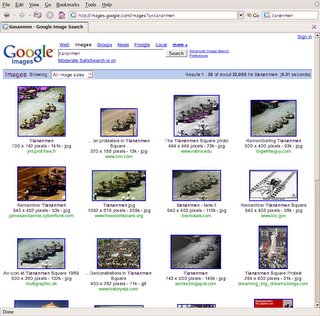
And here's "tiananmen" on Google.cn on the same day:
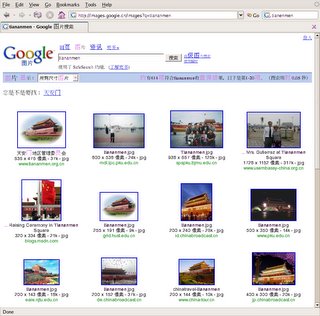
Well, it's pretty damning. So, suppose Google pulls out of China. Microsoft and Yahoo, you can have this market. What does that future look like? Microsoft hasn't launched its image search in China, but conveniently Yahoo has. Here's "tiananmen" on Yahoo USA's image search the same day:
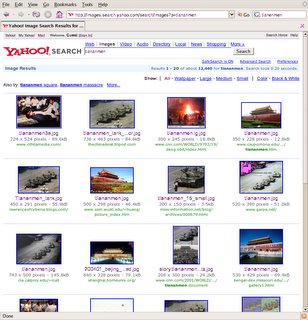
And here's "tiananmen" on Yahoo China:
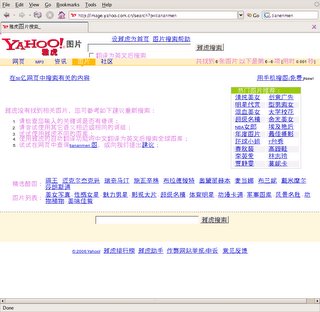
I can't read Chinese, so I can't tell if Yahoo's message actually informs the user that the search result has been censored, or opts for the more Orwellian claim that no images match that search term. However, it seems clear that Yahoo's doing no better than Google here. Where are the hundreds of headlines, and the massive outcry among the chattering classes, about Yahoo's censorship? Where are the calls to boycott Yahoo, the satirical cartoons, the bitter debates on online forums?

One might argue that Yahoo never claimed to do no evil. Well, OK, but I don't believe that such an omission really absolves them of guilt. And this answer doesn't address the uncomfortable fact that removing Google from China doesn't actually improve the lot of Chinese Internet users, who will simply be forced to use some other search engine that's also censored, and perhaps more severely.

A better answer, then: the fact that somebody else will perform some evil is no excuse for becoming implicated in that evil oneself. So, only evil companies may operate in China; let China be served by evil companies, and let us keep our hands clean.

This idea has some emotional appeal, and even some merit, but one must choose carefully where and when to apply it.

Some cases are clear. Should one provide census machines to the government of Nazi Germany, as IBM's German subsidiary did in World War II? Of course not, at least not knowing what we know today: no conceivable use of these machines could accomplish anything but evil. No matter that somebody else might build similar machines. Let the blood be on their hands.

Other cases are less clear. Should one provide a censored search engine to Chinese Internet users? Well, can one conceive of uses of a censored search engine that would accomplish non-evil, or even positively good things? In fact, such uses seem not merely possible but probable.

As evidence for this, observe that the vast majority of American Google users search with the SafeSearch censorship feature enabled. This censorship can be turned off, but my point is that people find even the censored product non-evil enough that they still use it, and most cannot be bothered to turn it off. I, for one, use Google constantly, and it seems ridiculous to believe that depriving Chinese users of a similar (albeit more heavily censored) service would somehow advance the cause of freedom.

Furthermore, the presence of more search engines in China seems like a positive good in itself. First, more search engines means more labor for the censors, which makes censorship more costly, which means that there will be quantitatively less censorship, or at least less comprehensive enforcement of censorship, than there would be otherwise. Second, for the foreseeable future, Internet filtering technology will always be imperfect. Multiple engines, with their different underlying algorithms, will inevitably censor things in subtly different ways, and so having more engines increases the likelihood that any given piece of information will leak through at least one of their sieves. Therefore, the Chinese government is fighting a losing battle, and the presence of more search engines may, in some small way, accelerate the day that the censors admit defeat.

I am not naïve enough to believe that these considerations were the only ones spoken of when Google's executives were mulling over the decision to comply with the Chinese government's demands. In fact, I don't believe that they even seriously considered the option of pulling out of China completely. But the bottom line is that, upon reflection, I can't say with any certainty that Google should have pulled out of China.

I.

So door number two closes --- which I regard with much more ambivalence than the closing of door number three --- and we are left with the sad compromise of door number one.

In walking through this door, Google still commits itself to a series of gambles. Google's betting that its brand will survive the negative PR from collaborating with the Chinese government. It's also betting that the Chinese government will be placated by relatively modest concessions, and will not demand deeper, more cutting compromises that, whether acceded to or refused, would diminish the payoff from its current bet. If, for example, the Chinese government demands all of Google China's search logs, then Google will face these three doors again, only the stakes will be even higher and the likely price even steeper. Will Beijing come to collect this pound of flesh someday? I really don't know.

In the meantime, Google's critics will continue to blame them for failing to come up with a neat and tidy solution to an ultimately intractable problem. Without outrage, nothing ever gets accomplished, so I can't exactly blame those who are outraged, but nor can I agree with them. There are some merits to Google's argument in defense of its decision, just as there are merits to the argument that they should act differently. In the end, this issue won't have a clean resolution as long as China remains unfree.