Showing posts with label social-justice. Show all posts

Monday, October 12, 2009

Coase and Pareto optimality illustrated

The Coase Theorem states that absent transaction costs, a Pareto efficient outcome will be arrived at regardless of the assignment of rights in an economic transaction. This theorem and its implications are a common source of confusion, which I attribute to the relatively dry examples typically used to illustrate the theorem --- commercial property easements, etc. Here is a more vivid illustration, which may clarify matters.

Suppose I want to shoot you in the face. With a gun. Suppose I value this experience at X dollars. Suppose, also, that you value your face at Y dollars. The Coase theorem predicts that both the outcome and the global welfare thereof will be the same regardless of whether

  1. I have the legal right to shoot you in the face.
  2. You have the legal right not to be shot in the face.

You can prove this by breaking it down into cases:

  1. Suppose Y > X; that is, you value your face more than I value shooting you in the face. Then consider the two possible assignments of rights:
    1. Suppose I have the right to shoot you in the face. Then you will pay me $X plus a penny not to shoot you in the face. Your welfare will be $Y - ($X plus a penny), and my welfare will be $X plus a penny. The total welfare will then be $Y - ($X plus a penny) + ($X plus a penny), or $Y.
    2. Suppose you have the right not to be shot in the face. Because Y > X, I will not pay you enough to let me shoot you in the face. You will have your face, which is worth $Y. I will have nothing. The total welfare between the two of us is then $Y.
    Notice that in both cases, you do not get shot in the face, and the total welfare is $Y.
  2. Suppose, on the other hand, that Y < X; that is, I want to shoot you in the face more than you value not being shot. Now consider the two subcases:
    1. Suppose I have the right to shoot you in the face. You will not be willing to pay me $X, because you only value your face at $Y. I will shoot you in the face. Your welfare will be -Y dollars. My welfare will be X dollars. In this case, the total welfare is $X - $Y.
    2. Suppose you have the right not to be shot in the face. Because Y < X, I will pay you $Y plus a penny to let me shoot you in the face. Your net welfare will be a penny, because you got shot in the face, but got paid $Y plus a penny. My welfare will be X minus Y dollars plus a penny. The total welfare between the two of us is $X - $Y, plus a penny minus a penny, which is $X - $Y.
    Notice that in both cases, you get shot in the face, and the total welfare is $X - $Y.

So, the outcomes are the same, and the total welfare is the same. Clearly, it does not matter whom we assign the rights to, right?

Right. Back here on Earth, any thinking person will be prompted to make a few observations.

First, although total welfare is the same, the balance of welfare may be dramatically different. Consider the difference between A.1 and A.2: if I have the right to shoot you in the face, you have to pay me not to; but if I do not, then you have to do nothing and you get to keep all your money. So the Coase Theorem says nothing whatsoever about distributional justice.

Second, you may observe that I have made an unwarranted assumption that the person being paid off in A.1 and B.2 will accept a mere penny extra to change his/her behavior. In fact, the person being paid off might observe that the welfare surplus (the difference between $X and $Y) can be larger than a penny, and bargain for a larger fraction of that surplus. Logically, the "buyer" in each case ought to be willing to pay the maximum price minus a penny. For example, if I value shooting you in the face at $X, I ought to be willing to pay $X minus a penny for the privilege of shooting you; in fact, every payment between $X minus a penny and $Y plus a penny is Pareto optimal and the Coase Theorem has nothing to say about how much money will actually get transferred. In practice, of course, this would be determined by social norms, unequal distribution of prior capital, and other "social" stuff that economists usually prefer to ignore the existence of.

Third, we have made no mention of "human" or "natural" rights. And indeed the Coase Theorem is a completely amoral observation about (an idealized model) of bargaining. I hope you believe it would be monstrous for society to give me the right to shoot you in the face, with your only recourse being to pay me off not to do it. The Coase Theorem tells us that both assignments are "efficient" (Pareto optimal). But of course there's a world of difference between the two.

So basically, the Coase Theorem is a cool little mathematical widget that, by itself, offers almost no guidance in real world policy questions. In combination with other concepts, it's no doubt a useful widget for economists. But when it appears unadorned in laypersons' rhetoric, its most common purpose, as far as I can tell, is to obscure fundamentally normative disagreements about distributional justice, social inequality, and moral principle. Mathematical concepts like Pareto optimality are objective --- they assume no particular moral values or social context --- but neither does a gun, and yet when somebody points a gun at your face there's no mistaking the malign intention.

Saturday, November 18, 2006

Growth vs. equality, investment vs. consumption

This week there was an interesting discussion between Tyler Cowen and the Crooked Timberites about economic policies that favor growth versus those that ensure social welfare. This post at MR and this post at CT will give you the gist of the argument, which is more about relative levels of national wealth, but the underlying question is one of balancing economic growth against other aims.

There's a notion, somewhat popular among (economically) right-leaning types, that economic growth overrules almost every other concern, because in the long run even the bottom of the wealth distribution benefits more from growth than from redistributive policies. Truthfully, I don't understand this line of reasoning.

First of all, the bottom of the income distribution in fifty years consists of different people from the bottom of the income distribution now. It's unclear that the moral status of potential future people strictly exceeds that of actual present people.

Second, this whole debate is just a standard tradeoff between investment versus consumption, like any other, and in such cases some consumption is generally warranted even if it means sacrificing some investment. I could have a really awesome retirement if I decided right now to live in a cardboard box, sell my car, live on a subsistence diet, and invest all of the money I save. This policy favors economic growth, but it's also insane.

Likewise, if a family has two children named Alice and Bob, you can ensure nice retirement funds for both by making Bob live in a cardboard box in the yard, feeding him cheap bland food, clothing him in rags, and putting all the money you save into a shared retirement fund for Alice and Bob. As long as Bob stays in school, gets good grades (you can always threaten to take away his box), and gets a job, this strategy favors long-term economic growth. But that would be equally insane, and unfair besides.

Analogies based on well-known time horizons (one human lifetime) don't scale up straightforwardly to indefinite time horizons (however long humanity will be (1) nonextinct and (2) actually running the show). However, I think the core insights carry over. Poverty reduction and economic justice in the present are goods; "spending" on them through redistributive policies can be viewed as a form of consumption.* A society with vast levels of poverty or economic injustice is undignified and painful, in the same way that living in a cardboard box is undignified and painful. If society must trade off some investment for consumption to achieve what we view as an acceptable "lifestyle" today, then so be it.

Of course, this analysis suggests we should also care about economic growth: you don't want to prioritize consumption over investment in all cases. But now we're just haggling over price, if you will. In order to argue for either more growth or more of something else, you have to propose an intellectual framework for balancing growth against other values. It's completely insufficient to pull out the benefits of growth and call that a trump card.

* I am pretending, here, that redistributive policies are never investments. Of course, that's false in many cases. For example, both equalizing educational opportunity and improving childhood health clearly improve long-run economic growth. Achieving these goals in our society clearly requires some amount of wealth redistribution.

Monday, March 20, 2006

On the draft

Jo-Ann Mort at TPMCafe revisits the notion of conscripted national service, using the standard argument that universal service will make it politically harder to send people to war. This issue keeps cropping up from time to time in liberal intellectual circles. I'm not sure exactly how I feel about a draft, but I have three comments.

First, I find the spectacle of middle-aged pundits advocating a draft for young people rather suspicious. It reeks of the same somebody-else-pays mentality that the draft supposedly eliminates. If we're going to have universal national service, then let's make it really universal: make everybody eligible for the draft, except for retirees and people who have previously served. The military's so-called "tooth-to-tail" ratio --- i.e., the proportion between the number of "tooth" soldiers serving on the front lines, and the logistical "tail" that supports them --- is something like one to seven. There are plenty of support occupations, both stateside and overseas, that don't require great physical exertion. Anybody of reasonably sound mind and body could fill those roles, not just the young. This becomes even more true if we adopt the proposal, favored by many liberal draft proponents especially, that national service could encompass civilian service.

I don't really buy the usual arguments for drafting the young only. Do older people have careers that might be interrupted? So do young people, who often have once-in-a-lifetime opportunities that they'd be forced to pass up; consider what would have happened to Sergey and Larry if they'd been drafted in 1997, when they were in their mid-twenties. Do older people have families to support? So do many of the younger people who'd be drafted (a point that may be lost on pundits because children of the mandarin class tend wait till they're approaching thirty). And is it better for a parent to be absent when the child's learning to speak than when the child's in high school? Six of one, half-dozen of the other, it seems to me.

Furthermore, all the arguments for universal service for the young become even stronger when you expand the draft to all ages. It will be even harder to go to war, because an even larger fraction of society will be affected. Society will benefit even more, because there will be even greater mixing, not only among social classes but between generations.

Now, I've elided some distinctions here, and I should un-elide them. One can envision two forms of universal service. First, one could have a deterministic universal service requirement, akin to what Israel currently has --- i.e., mandatory national service, at a certain age, for everybody in society. Second, one could have probabilistic universal service, which is what happened to people 18-25 during the Vietnam draft --- i.e., you live your life as usual, and someday your number might come up. My proposal above, for universal service for all ages, could be interpreted in several ways:

  1. Adopt deterministic service, but use probabilistic service as a transitional proposal to "grandfather in" all the people who never had to serve.
  2. Adopt probabilistic service for all time; this proposal comes with two variations:
    1. Permit everyone to avoid the draft by volunteering anytime before their number comes up.
    2. Disallow some fraction of people born in each year from volunteering before their number comes up.

Proposals (1) and (2a) are relatively self-explanatory, and would probably work out fairly similarly in practice. Most people would take their service early in life, and at a time chosen so that they could control the disruption involved, in order to avoid being hit by an unpredictable draft.

The final sub-option --- disallowing some people from volunteering --- is, I think, the most interesting. The reasoning goes like this. When only the young serve, the burden of war falls disproportionately on the young. (Yes, people have families, but still, going to war personally is an even greater life disruption than sending someone in your family to war.) This disadvantage still holds when service is universal: although everyone serves, the current cohort of older people at any given time knows that it will not have to serve in any war that society undertakes. Therefore, one should always "hold back" some people from every cohort, preventing them from taking their service when they're young, so that every age group contains some people who might be drafted in any given war.

Next, my second point. Some people will always be able to avoid dangerous combat, one way or another: witness G. W. Bush and the National Guard. The point of a draft isn't to institute perfect universal service, but to drive a wedge between the extraordinarily well-connected and the merely well-to-do, or in other words between the top 0.1% and the top 2%, a split that (sadly enough) would have huge consequences for American politics. I confess I'm not entirely comfortable with using human life and death as a political instrument, but I also suspect that my analogues speaking for the top 0.1% don't feel the same squeamishness.

Finally, my third point: instituting a draft doesn't mean being forced to fight in unjust wars. Even if a draft were instituted, you would always have a principled way to avoid fighting in a war that you oppose: go to jail. That may not sound like much of a choice, but as a protest of last resort, it is always available.

Thursday, March 16, 2006

On choosing to refuse parenthood

M. Yglesias comments on a Slate article (the latter, being by Will Saletan, is a thoroughly ignorable piece of piffle, so don't bother clicking his link):

Ah, yes, the time-honored dorm room debate if women can get abortions, why do men need to pay child support? has reached the big time in recent days. This doesn't strike me as an especially difficult question to answer. Insofar as a child is going to be born, that child is going to need to be supported. The resources for doing so need to come from somewhere. Obviously, many of those resources are going to wind up coming from his mother. But given the realities of the world, those resources are often going to be inadequate to the task. There are basically two additional sources of resources -- the child's father and the state. Current policy relies on a mix of the two.

Maybe a respectable case could be made for shifting the mix somewhat in the direction of the state, though one would want to see the details before signing on to this. I don't at all think a respectable case can be made for reducing the quantity of resources getting directed to children.

I had trouble sleeping last night, so I wrote a great deal about the subject, but then I woke up this morning and decided not to inflict the fullness of my ramblings on you all. So here's the executive summary of my response.

First, government's pretty good at collecting general tax revenue, and then mailing checks drawn on that fund to people who need them. On the other hand, it's pretty bad at micromanaging point-to-point transfer payments. Social Security supports widows and orphans via the former model, and it works pretty well, with very low overhead and broad public support. The current child support system uses the latter model, and it works terribly. As a purely utilitarian matter, this argues for making child support work more like Social Security, where society at large picks up the burden rather than non-custodial fathers.

Second, under present legal and social norms (outside of South Dakota, anyway), women possess an unconditional right to refuse parenthood after conception. There are roughly two justifications for this right: first, biological realities (the fetus is inside a woman's body, and does not constitute an independent human life); and second, the value of personal autonomy (a woman should not be forced to become a parent against her will). If you don't believe in the second justification, examine this NOW press release on empirical studies of why women choose to have abortions. The stated justifications are based largely not on the biological burden of pregnancy per se, but on the social, financial, legal, and moral burdens of parenthood. That burden's severe enough that it should not be imposed involuntarily. Therefore, it seems to me that people (both men and women) should ideally possess an unconditional right to refuse parenthood after conception. The means of exercising this right may be technological (abortion, for women) or legal (disavowal, for both men and women), but the option should exist.

Notice that I say "unconditional right". A woman's right to an abortion should not be conditional on whether she used contraception, or whether she talked to her partner about children before sex, or whether some judge thinks she's a slut. Women possess that right unconditionally, for good and obvious reasons. All the same reasons apply to men who wish to refuse parenthood. Advising men to talk to their partners and work out a sensible contraception policy, or live with the consequences, ignores the possibilities of carelessness, disagreement, miscommunication, confusion, accident, deceit, and all the manifold complexities that emerge in actual human affairs.

Of course, until society provides the hypothetical social safety net for all children, it's folly to destroy the current child support system. In some sense, therefore, there's not much point in talking about all this. But still, I think it's incredibly callous to dismiss the concern of men who don't want their only choices to be abstinence or potential fatherhood (Yglesias's post doesn't do this, but this attitude does appear in other things I've read).

Sunday, February 12, 2006

Of China, search engines, heroism, and capitalism

Full disclosure: I might end up working for Google at some date in the future. I believe that this didn't much affect my conclusions in what follows, but you should judge for yourself.

III.

I'm somewhat late to the party on this, but there's been a lot of outrage lately at Google's decision to submit to state censorship of its search results in China.

Notice my phrasing: Google's submission to state censorship by the Chinese government. I don't mean, by this construction, to absolve Google of blame, but I think Google's critics haven't been clear enough about what they are requesting.

Google has three choices. Door number one: it could comply with Beijing's demands. Door number two: it could cease all operations in China, ceding the market to its competitors. Door number three: it could refuse Beijing's demands and continue operations in China, thereby transforming its China operations into an unlawful radical political organization, and its employees in China into de facto dissidents.

Most of Google's critics have not stated which door they prefer, but I take it that a lot of them would prefer to see what's behind door number three. Google would thereby call China out, leading to a political confrontation. Would China take the international PR hit that would come from shutting down Google China? I don't know for certain, but I suspect they would. In the grand scheme of things, Google's not a big deal for an entity like the Chinese government.

I could then imagine some grand and surreal pageant wherein Larry or Sergey flies incognito to China, equipped with a laptop and a stack of Linux boot CDs, and ducks into a shady cybercafe. The Google founder, brandishing a fistful of thousand-dollar bills, convinces the cafe owner to shoo all the other patrons out. He then reboots all the cafe's machines, loading them up with proxies that tunnel surreptitiously back to Google HQ in Mountain View. He tells the owner to get out of town forever before the secret police come, for he is deputizing the cafe into an impromptu replacement for Google.cn. It is an absurd and symbolic gesture only: a couple dozen cybercafe machines cannot possibly serve the load for Google.cn; the response is sluggish to nonexistent; but for an hour, a day, Google.cn lives! And when the secret police come, these machines broadcast to the world, via live webcam, the stuttering, half-a-frame-per-second, pixelated video of the Google founder, being led away in handcuffs, and --- the compression artifacts make it hard to see, but --- is that a hood over his head? The repercussions of this quintessentially twenty-first century event resonate for decades to come, for this is just the beginning...

Well. The vision dims, the lights go out, the door shuts. I step backwards into reality.

Door number three is by far the most interesting door. It's the door that would open in a Bruce Sterling novel. However, reality is not, despite some indications, actually a Bruce Sterling novel. The tale I've just spun is entertaining partly because it is so unlikely. I may wish, on some level, that Google had decided to be heroes, but mostly in the same way that I wish all people were heroic more often --- which is to say, I wish it without any strong expectation that that the wish will be fulfilled. And, of course, sitting safely behind my laptop in a country where, for the moment at least, I am in no danger of being jailed merely for posting something on the Internet that offends the government, I would certainly enjoy the spectacle of Google taking on China. Still, my wish to be inspired and entertained collides with my realism, and I am unsurprised that these things do not come to pass.

So what, then, of "Don't be evil"? I think the astonishing fact that people swallowed this bromide testifies to how devoutly they wish that capitalism possessed more benevolence and less efficiency than it actually possesses. Post-millennial Americans, especially, crave heroes while simultaneously being so wedded to capitalism that they cannot accept that capitalism alone cannot produce certain kinds of heroism. The two virtues of capitalist heroism, insofar as capitalism specifically engenders any heroic virtues at all, are (1) cleverness and (2) the relentlessly single-minded pursuit of the satisfaction of a market demand. Alas, the English language has no stirring and pithy name for the latter virtue, but I do believe it can be a stirring sight, in the right circumstances.

Nevertheless, it is emphatically not capitalism, but something else, that breeds the reckless altruism required, for example, to stand alone before a column of tanks armed with nothing but a briefcase and one's sense of human dignity.

Now, of course, human beings living under capitalism do possess qualities beyond those of capitalism itself --- contra Marx, economics is only one of many interlocking systems which, in combination, knit our characters together. But businesses, although composed of human beings, are not human beings. A business is a social organism with a particular mission which is, barring exceptional circumstances, neither explicitly political nor altruistic. This doesn't absolve the individual human beings who run the business of their moral culpability, but it does tell us how to calibrate our expectations of businesses in general.

If we want to alter the course of politics in China --- or, for that matter, anywhere else --- then we should look primarily to governments and other political organizations, not businesses.

II.

So much for door number three. Let's have a look behind door number two. What if Google were simply to cede the Chinese search engine market to its competitors?

We can answer that question by looking at the behavior of Google's most credible competitors, Microsoft and Yahoo. Consider the much-invoked comparison, probably first suggested by Sid Karin on the interesting-people mailing list, of image searches for "tiananmen" on both Google.com and Google.cn. Here's "tiananmen" on Google.com (i.e., Google USA) as of 10 Feb 2006:
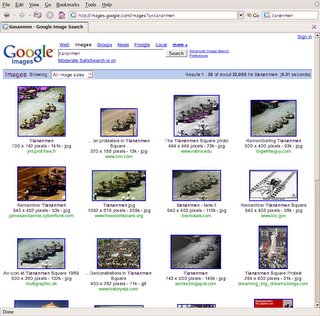
And here's "tiananmen" on Google.cn on the same day:
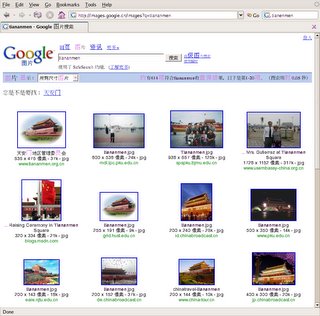
Well, it's pretty damning. So, suppose Google pulls out of China. Microsoft and Yahoo, you can have this market. What does that future look like? Microsoft hasn't launched its image search in China, but conveniently Yahoo has. Here's "tiananmen" on Yahoo USA's image search the same day:

And here's "tiananmen" on Yahoo China:

I can't read Chinese, so I can't tell if Yahoo's message actually informs the user that the search result has been censored, or opts for the more Orwellian claim that no images match that search term. However, it seems clear that Yahoo's doing no better than Google here. Where are the hundreds of headlines, and the massive outcry among the chattering classes, about Yahoo's censorship? Where are the calls to boycott Yahoo, the satirical cartoons, the bitter debates on online forums?

One might argue that Yahoo never claimed to do no evil. Well, OK, but I don't believe that such an omission really absolves them of guilt. And this answer doesn't address the uncomfortable fact that removing Google from China doesn't actually improve the lot of Chinese Internet users, who will simply be forced to use some other search engine that's also censored, and perhaps more severely.

A better answer, then: the fact that somebody else will perform some evil is no excuse for becoming implicated in that evil oneself. So, only evil companies may operate in China; let China be served by evil companies, and let us keep our hands clean.

This idea has some emotional appeal, and even some merit, but one must choose carefully where and when to apply it.

Some cases are clear. Should one provide census machines to the government of Nazi Germany, as IBM's German subsidiary did in World War II? Of course not, at least not knowing what we know today: no conceivable use of these machines could accomplish anything but evil. No matter that somebody else might build similar machines. Let the blood be on their hands.

Other cases are less clear. Should one provide a censored search engine to Chinese Internet users? Well, can one conceive of uses of a censored search engine that would accomplish non-evil, or even positively good things? In fact, such uses seem not merely possible but probable.

As evidence for this, observe that the vast majority of American Google users search with the SafeSearch censorship feature enabled. This censorship can be turned off, but my point is that people find even the censored product non-evil enough that they still use it, and most cannot be bothered to turn it off. I, for one, use Google constantly, and it seems ridiculous to believe that depriving Chinese users of a similar (albeit more heavily censored) service would somehow advance the cause of freedom.

Furthermore, the presence of more search engines in China seems like a positive good in itself. First, more search engines means more labor for the censors, which makes censorship more costly, which means that there will be quantitatively less censorship, or at least less comprehensive enforcement of censorship, than there would be otherwise. Second, for the foreseeable future, Internet filtering technology will always be imperfect. Multiple engines, with their different underlying algorithms, will inevitably censor things in subtly different ways, and so having more engines increases the likelihood that any given piece of information will leak through at least one of their sieves. Therefore, the Chinese government is fighting a losing battle, and the presence of more search engines may, in some small way, accelerate the day that the censors admit defeat.

I am not naïve enough to believe that these considerations were the only ones spoken of when Google's executives were mulling over the decision to comply with the Chinese government's demands. In fact, I don't believe that they even seriously considered the option of pulling out of China completely. But the bottom line is that, upon reflection, I can't say with any certainty that Google should have pulled out of China.

I.

So door number two closes --- which I regard with much more ambivalence than the closing of door number three --- and we are left with the sad compromise of door number one.

In walking through this door, Google still commits itself to a series of gambles. Google's betting that its brand will survive the negative PR from collaborating with the Chinese government. It's also betting that the Chinese government will be placated by relatively modest concessions, and will not demand deeper, more cutting compromises that, whether acceded to or refused, would diminish the payoff from its current bet. If, for example, the Chinese government demands all of Google China's search logs, then Google will face these three doors again, only the stakes will be even higher and the likely price even steeper. Will Beijing come to collect this pound of flesh someday? I really don't know.

In the meantime, Google's critics will continue to blame them for failing to come up with a neat and tidy solution to an ultimately intractable problem. Without outrage, nothing ever gets accomplished, so I can't exactly blame those who are outraged, but nor can I agree with them. There are some merits to Google's argument in defense of its decision, just as there are merits to the argument that they should act differently. In the end, this issue won't have a clean resolution as long as China remains unfree.