Showing posts with label social-software. Show all posts

Saturday, February 06, 2021

Freedom of speech, and how to reason productively about it

Most people develop opinions about how speech should be restricted via a priori reasoning from abstract principles, often absorbed from primary school civics lessons or other tribal recitations (for example, these days, social media memes).

But in a consequentialist, utilitarian framework, how discourse should be regulated depends on several empirical questions:

  • Speech is a physical reality; the speech that occurs in a given medium can be measured.
  • The beliefs, behaviors, and harms that a system of speech engenders are also physical realities, and also to some extent measurable.
  • The effects of a given mode of speech regulation are also measurable realities.

To put it another way, media are systems with particular mechanics, like games; Twitter is a different game, for example, than Reddit, and both are different from digital journalism or cable news. The mechanics of a medium drive higher-level emergent dynamics, which (for nontrivial systems) can only be studied empirically. The proper instruments of study cannot be drawn from the toolkit of a priori philosophy alone; they require the methods of science and engineering: experimentation, simulation, modeling, comparison of modeling predictions against empirical data.

I posit that any practicing computer game designer could easily design a "speech game" where bad speech totally drives out good. In fact, this would be so easy that the only design challenge would be making it fun enough that anyone would want to play. As a player of that game, you would be a fool to embrace the strategy that "the remedy to be applied is more speech" (quoting Brandeis); you would simply be crushed; your adversaries would laugh at your naivete. I hope this idea seems obvious to you. But are you certain that we aren't all playing such a game in one or more spheres of real life?

It is sad to me that so much effort is spent (wasted!) arguing in totally unproductive circles about some aspect of free speech ("censorship", "cancel culture", "deplatforming", etc.), and so little effort is spent understanding empirically the connection between mechanics and dynamics.

Friday, September 29, 2017

Tentpole sponsors: an idea for improving paid service virality

Ad-supported communication platforms like Facebook have many structural advantages over hypothetical competitors that charge users money directly. One advantage is that a purely ad-supported service can spread virally, from user to user, at a vastly greater rate than a service that demands direct monetary payment.

For most users, the unpredictable, frequently unmeasurable harms of losing privacy and control over their social identity are less tangible than the direct time and money cost of signing up for a paid software subscription [0]. Thus free services which strip-mine your privacy and lock you into their prison spread like wildfire, while paid services that respect their users barely get off the ground. It seems that every large social networking service on the Internet has been hammered on the anvil of this seemingly inescapable logic and beaten into a Facebook-like shape.

However, user preferences vary. One can conjecture that within any social network subgraph of size N (for some N), there exists at least one user who cares an unusual amount about privacy and control. This user might be willing to subsidize a large subset of their local subgraph. Let R be the ratio of the local neighborhood of size N that such a user is willing to subsidize.

If N and R have the right values, a possible hack for the virality problem is to charge money to these special users — call them "tentpole users" — and allow them to sponsor the addition and ongoing use of the users around them. Most users will not be tentpoles; but given enough poles, positioned appropriately, the tent may be lifted over the entire addressable user population.

In the most basic form, you can imagine that a paid subscription gives every user a certain number of tokens, which they can use to sponsor accounts for their friends and family. When a new user is invited, some tokens would be allocated to them — one to support that user, and optionally some extra tokens gifted so that they could invite more users in turn. A non-sponsor user who wants additional invitations beyond their starter set would purchase more, thereby becoming a sponsor, or ask their network for some spare tokens. Sponsorship would be fungible — that is, users would be able to change their sponsor at any time — but every user would be either a sponsor or a beneficiary or both.

In principle, with proper tuning, most users could be beneficiaries, and pay nothing. A service engineered this way would be closer in virality to an ad-supported one. (It's still not quite as viral; for one thing, there is still some real friction at the edge of the "sponsorship radius", the distance from a sponsor at which users run out of tokens for further invitations. This needs further thought.)

Another model would allow all users to join free of charge, but grant additional privileges to sponsored users. This works, economically, as long as the aggregate cost of free-riding users is less than the total revenue from sponsors. This "tentpole freemium" model resembles an ordinary freemium model (where only the sponsors themselves pay [1]); arguably it is simply a freemium model where one of the premium benefits is improved amenities for one's contacts.

When I mentioned these ideas to a colleague a few months ago, he immediately pointed out that tentpoling leads to a situation where sponsored users are socially indebted to their sponsors. This has at least two effects. First, debt potentially causes social awkwardness, and this risk must be navigated (c.f. V. A. Zelizer). Second, users may feel a sense of precarity because sponsorship could end (for example, if their sponsor cancels their subscription), and thus would be reluctant to adopt the platform. These are definitely challenges, but it may be possible to overcome them.

Social awkwardness may be amenable to psychological hacks which obfuscate the transactionality of the interaction. To invent a silly example, one can imagine a social network where your profile picture can be decorated with a virtual hat, which degrades over time. You can only remain on the service if your profile has a hat; sponsors receive a certain number of hat credits, which they can use to purchase various hats and gift them to their peers. Lastly, any user can trade or gift a hat that they possess. The combination of these mechanics makes the act of "wearing" a hat expressive, not merely pecuniary; wearing a hat that one of your friends obtained and gave to you can be construed as a fun social act which strengthens your friendship, rather than a purely financial necessity. By adjusting the number of hat credits that sponsors get, you can create enough liquidity in the system that most active users have multiple hats. Therefore, it is possible to beg your friends for a particular hat without disclosing that you just don't feel like buying any hats — for example, a user who doesn't want to pay for the service might ask "Hey, anybody got a spare blue knit cap? My last one is expiring next week." A certain degree of strategic ambiguity is preserved.

This example is crude and probably too nakedly gamified to work, but I hope it illustrates that there is a gigantic space of possibilities for designing the social character of sponsorship. Somewhere in that space, I conjecture that there is a point where people are comfortable with sponsor-beneficiary relations in a social network.

Precarity may also be amenable to engineering solutions. For example, one could allow and encourage users to be sponsored by multiple people, and then grant enough tokens to sponsors that their "radius of influence" would, in practice, always overlap with other sponsors'. Then, in steady state, most users would feel secure, because they would be sponsored by more than one person. And in a tentpole freemium model, users would always continue to have access to their identity even when sponsorships expire, reducing the downside even if one were to lose all of one's sponsors.

Have there been examples of tentpole sponsorship as a business model in the wild? I have trouble thinking of them.

Anecdotally, one sometimes hears of people buying paid Slack workspaces to socialize or organize activities that are not part of their day job. I assume that there are usually free riders in this arrangement. So, Slack may have stumbled on this model without intending to (obviously, Slack's primary revenue stream is charging businesses for employee accounts, which is socially a very different scenario, although arguably isomorphic to tentpole sponsorship in some ways).

Alternatively, one could argue that whenever a highly technical user sets up a custom email domain for their family, rather than just signing everyone up for Gmail, they are tentpoling the base protocols of the Internet. The difference, I guess, is that sponsorship is not fungible: if you set up a domain for your family, your child cannot change their sponsor later in life without migrating to another domain, which incurs various transition costs.

The last example I can think of is in gaming. In some multiplayer games like Lineage, players can organize into clans, and clans can purchase in-game collective goods. I've never played Lineage, but I assume that players within a clan differ in their level of contribution, and thus the most committed players are effectively sponsoring the rest.

Overall, however, I think the idea of tentpole sponsorship has seen little use, and this seems like a space that is ripe for experimentation.


Having read this, your reaction might be (probably should be!), "Talk is cheap. Ideas are cheap. What are you gonna do about it?"

Alas, I have to admit that the answer is very little.

To really pursue this idea would be multi-year effort, and there are all kinds of reasons that this does not seem like the thing that I want to spend the next few years building. (For one thing, a half-hermit misanthrope like me is probably one of the worst people in the world to try building a social network.) So, instead, I'm throwing this post out there in a sort of cry to the universe, both to get it out of my head, and also in the vague hope that it infinitesimally increases the probability that somebody will figure out how to make it work.

This may be the dumbest theory of change that's ever been written down, but it's about what I can muster at this point in my life. On the other hand, if you back up and squint, in 2009 I predicted (sort of) both the business model of Patreon and Jeff Bezos's purchase of the Washington Post, so maybe the universe will again cough up something resembling my half-baked ideas.


Bonus thought: once you have the idea of tentpoling in your mental toolkit, you will begin to see echoes of it in many places. For example, nearly every software package is sometimes hard to use. But some users have the inclination and capability to become expert in that software, and then spend effort helping others cope with it. These helpful experts are technical (rather than financial) tentpoles, paying the cost of onboarding and support for users in some radius around them. Every geek who serves as tech support for their parents' devices is holding up the tent of Microsoft or Apple or Google or whatever over their family.

In fact, many instances of free riding can be thought of as tentpoling on some level. I suppose the difference between the concept of tentpoling and free-riding in general is that tentpoling is voluntary and has a significant dimension of locality in the social graph.
[0] Arguably, there is also a market in lemons for software services that offer users privacy and control. This is a separate issue and much too big to tackle in this post.

[1] On a vaguely related note, observe that Maciej Ceglowski has repeatedly suggested that Twitter should adopt an ordinary-freemium model where users just pay money for additional features. It is an interesting thought puzzle to contemplate why Twitter has never even experimented with doing this. There seems to be a real organizational dynamic in business that once a company settles on an advertising-supported revenue model, this sucks up all the oxygen necessary for alternate revenue models to breathe, and I do not entirely understand why. Consider how long it took for YouTube to offer YouTube Red; although this is also a case which proves that it is not impossible for the alternative model to break through.

Monday, September 25, 2017

What's the point of Facebook alternatives?

It is clear at this point that Facebook has a monopoly on online human-to-human interaction that no private forces, market or otherwise, will break in the foreseeable future. The network effects from a billion users are unsurmountably large. If we take Metcalfe's Law literally, even a social network that accumulates a hundred million users will be a hundred times less powerful than Facebook.[0] In fact, you're probably confused by the title of this post: What Facebook alternatives?

Facebook is furthermore unlike the other American technology giants in that it alone locks up all its users' interactions inside its walled garden. Apple, Alphabet, Amazon, and Microsoft are, to greater or lesser degree, porous at the edges — you can use an iPhone to chat with people who don't have iPhones; you can use Gmail to email people who don't have Gmail; buying things from Amazon doesn't prevent you from buying other stuff elsewhere; even Microsoft has realized belatedly that it is not the center of the universe & its products have started playing nice with others. But Facebook locks up your posts, locks up your photos, locks up your entire social identity inside its prison. There simply is no way to interact with Facebook users except by creating a Facebook account yourself and creating content that further entrenches Facebook's monopoly.

The gradual decay of open Internet protocols as human interaction disappears down the black hole of Facebook's ever-expanding digestive tract has been one of the great disappointments of my lifetime. In the end, AOL seems to have beaten the Internet after all.

I have opted for only de minimis engagement with Facebook, and more or less refuse to communicate via its platform. This has probably attenuated some of my relationships with people in a regrettable way (if you're somehow reading this and you wish this hadn't happened between us, send me email! it still works!) but the actions of conscientious objectors like me have not made the tiniest scratch on Facebook's dominance.

It is only a matter of time before governments realize that this entity must be regulated, whether under antitrust law or otherwise. The question is what will happen then.

In my opinion, it is clear what the ideal outcome would be: forcing Facebook to adopt open APIs that give users transparency, portability, and interoperability. Users should be able to see the data that Facebook has stored about them. Users should be able to export that data in toto to competing platforms. And users should be able to interoperate between Facebook and other social networks — a future version of Diaspora*, for example, should be able to see and interact with Facebook content generated by that Diaspora* user's social network, and vice versa; interactions between users across platforms should be reflected accurately on both sides. A user would thus be able to leave Facebook without severing their ties to the users they have left behind.

In a world where these APIs existed, users would have a way to reject Facebook's toxic business model and questionable privacy practices without exiling themselves from their social life. In Hirschmanian terms, users would have the option of exit, not just voice, as a way of signaling dissatisfaction. Facebook would probably even get healthier, as a product, as a result of the opportunity for meaningful competition.

This outcome is exceptionally unlikely. Government regulation of Facebook, although likely inevitable, is also likely to be ham-fisted and ineffective, simply because governments are terrible at understanding technology and rarely have the political will to impose effective solutions even if they knew of them. The last time the U.S. government, for example, used antitrust law against a technology monopolist, it basically bogged down the company in red tape for a decade but did little to meaningfully give its competitors an opening in the allegedly monopolized market. Windows is still by far the most widely used desktop operating system and the web browser that finally dethroned Internet Explorer on Windows did so through incredibly aggressive Internet marketing, not by using the remedies forced on Microsoft by antitrust law.

However, there is one thing that technologists might be able to do to make the desirable outcome marginally more likely, and that is to develop the protocols, and plausible implementations thereof, that would allow effective federated social networking to be mandated by government decree. Diaspora* may have made a significant dent in a subset of the technical problems, but there are significant open challenges inherent to federated social networking that I suspect have not been solved.

Critics of Diaspora*, Mastodon, etc. thus misstep when they observe that organic growth of these platforms is limited. The ultimate destiny of a successful federated social networking protocol, if one ever arises, will be to stock the toolkit of a future regulator, not to overtake Facebook via organic growth.

There is enormous inertia—a tyranny of the status quo—in private and especially governmental arrangements. Only a crisis—actual or perceived—produces real change. When that crisis occurs, the actions that are taken depend on the ideas that are lying around. That, I believe, is our basic function: to develop alternatives to existing policies, to keep them alive and available until the politically impossible becomes politically inevitable.

Milton Friedman, Capitalism and Freedom


[0] 100M is, to an order-of-magnitude approximation, the size of Snapchat's active user population. Observers who think Snapchat is a credible challenger to Facebook are off by a factor of a hundred, not a factor of ten.

Sunday, May 07, 2017

On the efficacy of online flamewars

Excavated from the drafts folder for no particular reason.

Isn't it great how, since the Brendan Eich affair, all his online defenders have become active labor rights organizers, fighting for workplace political freedom for all? Galvanized by the realization that not only CEOs but all workers deserve robust protections for their political beliefs, Eich's erstwhile defenders channeled all their passion into effective political action. Which is why Congress will vote this week on a bill with three key provisions: first, it outlaws any form of workplace discrimination based on political speech or activity conducted outside the office; second, it handsomely funds an investigative division of the FBI tasked specifically with working with the NLRB to track down and prosecute violators; third, by analogy with the Foreign Corrupt Practices Act and the 2003 Protect Act (which grants American prosecutors broad latitude to charge Americans who molest children while abroad), it makes it illegal for companies operating on American soil to subcontract work to overseas employers which restrict their workers' political rights.

There was never any danger that Eich's defenders would just basically forget about the whole affair and get on with their lives. Ha ha! Yeah that definitely couldn't have happened, given how deeply committed these people were to the principle of workplace political freedom. It's not like they only care about workers' rights when it's an incredibly wealthy white male celebrity who is being criticized.

Likewise, when the dead bloated corpse of patriarchy is laid to rest this fall, everyone will have to recognize that the great Twitter Flamewar of March 2014 was really the spike through its heart. No, not that one, I mean the other one, the one where we all wrote angry all-caps tweets at that one dude, he was totally mansplaining and stuff, you remember the one I'm thinking of.

Saturday, March 30, 2013

The web's original sin, and its possible redemption

Anil Dash made a good point last December, but he also missed something. The rot was there from the beginning. The original architectural sin of the Web was that, in the name of security, we made web browsers unable to communicate with each other directly. This made browsers completely dependent on server intermediaries, which inevitably centralizes power in the hands of those who can afford to run servers. Shortly thereafter, web browsers crowded out all other Internet client software, and that was all she wrote.

This was not the original design of the Internet. The Internet is an end-to-end system, not an end-to-middleman-to-end system. There is no fundamental reason that the software you run on your personal devices must be neutered so that it can't talk directly to other personal devices.

So, the current state of the Internet could be a temporary condition. Eventually, clients might regain the ability to open socket connections to each other directly, with discovery mediated by an open distributed protocol. Servers will still be important, but it will become possible again to write peer-to-peer protocols, and to distribute peer-to-peer client software that (unlike, say, Usenet nodes) has true mass-user accessibility and appeal.

Think of it this way. It is completely infeasible for Facebook to run its massive server farm without demanding some toll. But it is probably feasible for you to share status updates and pictures with the people you personally know, using only the spare computing power and connectivity that you all collectively own. You don't need a 1000-CPU-hour MapReduce to share baby pictures with your extended family. You need blob storage, an email-like store-and-forward messaging protocol, and a pool of hosts that's available and connected enough to distribute, say, 100 MB of data per person per week. If you're a middle-class citizen of the First World, there's an excellent chance that you and your social circle own enough computing resources to support this infrastructure already — provided those resources could be utilized properly.

Thus the most interesting thing about WebRTC is not even the real-time communication it enables (although that's pretty interesting!). WebRTC is the first step towards enabling users to send nontrivial quantities of bits directly to each other, traversing through common firewall setups, without a server intermediary and without any native client software other than a web browser.

However, WebRTC is only the first crack in the wall. Fully cutting clients loose from the server layer will be challenging. Peer-to-peer web apps will have to operate in an intermittently disconnected state, and serve content to each other reliably without the crutch of a reliable web host paid for by somebody else's money. This is a challenging computer science problem, involving aspects of system and protocol design, software engineering, and human computer interaction.

It will also be a challenging business problem: how do you convince people to use this application rather than the ones they are already used to? Facebook works well enough, if you squint and ignore confidentiality, transparency, and control with respect to your personal data. And disregarding hardware and networking costs, how does the software development itself get funded? Eben Moglen is an interesting thinker, and it seems true that when you spin the planet, software flows through the network, but I am not convinced the current induced thereby is strong enough to satisfy all our software needs.

But if we are truly to regain "the web we lost", we may have to hack around the fundamental economics of the web that replaced it.

Thursday, November 17, 2011

The social graph is...

"...neither social nor a graph..."

...provided you redefine the words "social" and "graph" to mean something other than what they mean to everyone else.

M. Ceglowski is just being deliberately obtuse, or more precisely he is taking a wild excess of rhetorical license in order to make his statements seem more profound and unconventional. For example, he writes:

We nerds love graphs because they are easy to represent in a computer and there is a vast literature on how to do useful things with them. . . . In order to model something as a graph, you have to have a clear definition of what its nodes and edges represent.

Well, that's actually bullshit. In a dynamic Bayesian network, you don't have a complete definition a priori of what nodes and edges represent. Well, you do, in that the nodes represent variables and the edges represent relationships between those variables, but the weights on the edges are learned statistically from data. An edge may represent a meaningful connection, or it may mean nothing at all. The graph precedes semantics, not vice versa. Likewise with the social graph. People are connected, and you don't necessarily know what each connection means. But it's still a graph.

The labels on the social graph's edges may be subtler and more multidimensional than the simple weights you put on Bayesian network edges. And we don't have a good handle on how to learn those labels, or even what the labels should be. However, calling for the abandonment of a useful mathematical construction in an emerging field of science because it's incomplete is something that you do when you want to convince people that you're smarter than the people working in that field. It's not something you do when you want people to become better-informed.

Ceglowski also writes that the social graph is "not social" because... well, actually, I have trouble even locating a coherent argument in that part of the essay. He seems to be confusing "social" with "sociable". The social graph is social, since it describes relationships between people. Perhaps some activity involved in digitally reifying the social graph is anti-social (Note that anti-social is not the opposite of social — anti-social behaviors are social behaviors!). But that doesn't make the social graph "not social". By that standard, sociology is not a social science because sociologists spend a lot of time by themselves in libraries.

Incidentally social scientists have been modeling social connections as graphs for decades.

Here is a short list of the valid points Ceglowski makes:

  1. FOAF relationship labels are kind of dumb and embarrassing.
  2. Manually maintaining anything other than a very coarse-grained digital reification of a social graph is a tedious chore.
  3. Making your social network and behavior the property of a company whose revenue model is not aligned with your long-term interests is a bad idea.

And here is a short list of other, non-terminological points that Ceglowski just gets wrong:

  1. Social networks do "[g]ive people something cool to do and a way to talk to each other". It turns out that sharing photos, videos, and links is one of the most broadly appealing online activities, and social networking sites seem to do this better (along some dimensions) than dedicated photo-, video-, and link-sharing sites.
  2. Judging communities by the outward-facing cultural artifacts they produce is a radically inadequate measure of value. The vast majority of communication is point-to-point, not broadcast, and the vast majority of interpersonal interactions are social grooming. Social grooming is a deep-seated primate instinct which nerds devalue at their peril. Social networks have made online social grooming far easier than their predecessors did.
  3. People on WoW, Eve Online, and 4chan have healthier social lives than people on Facebook? Really?

Note that I write all the above as someone who dislikes Facebook and is skeptical of reductive approaches to modeling social relationships. And I've been advocating* an end to proprietary social networks for years — long before I started working at Google, and in fact before Facebook was even the predominant social network. So I'm broadly sympathetic to Ceglowski's aims. But I don't like at all the way that he goes about explaining them.


*Incidentally, rereading this old post, I realize that I completely missed the possibility that the dominant social network site would simply become a huge platform for third-party applications. I guess it never occurred to me that serious companies would bet their livelihoods on being sharecroppers in the walled garden. Go figure. I could speculate that this willingness can be traced directly to the Valley vogue for building companies to flip rather than to create sustainable, decades-long sources of enduring value — if you're just holding on until your "liquidity event" then it doesn't matter that your business is built on the fickle forbearance of your platform landlord — but I'm not sure how right that is.

Sunday, April 03, 2011

Tree structure and comment threads (a brief observation)

It has been claimed that flat, linear presentation of comments appears to work better for humans than tree-structured comment threads. Without getting too deeply into whether this is true (and if so, why), I would like to offer an observation.

Conversation is never a tree; it is a general directed acyclic graph. In reality, in the commenter's mind, every comment potentially implicitly responds to an arbitrary subset of preceding comments, not to a unique parent and its chain of unique transitive ancestors.

Tree-structured threading — sometimes (erroneously!) called "true threading" — artificially imposes a tree structure on this graph. Flat, linear comment systems do not: each comment appears after all those that precede it topologically in the DAG, and it is up to the reader to reassemble the DAG based on the comments' contents.

It is true, of course, that flat comment systems fail to reify all DAG edges as explicit metadata. However, the nature of these edges is quite subtle and capturing them all explicitly is intractable. Often a comment "responds" to previous comments in indirect ways — for example, simply by omitting some aspect of the argument that has been covered by a previous comment.

(Prompted by a TC article linked off HN.)

Saturday, December 25, 2010

Email, instant messaging, immediacy, and productivity

Krugman's response to this NY Times trend article on the alleged death of email and triumph of instant messaging reminds me of Donald Knuth's explanation of why he doesn't use email:

Email is a wonderful thing for people whose role in life is to be on top of things. But not for me; my role is to be on the bottom of things. What I do takes long hours of studying and uninterruptible concentration. I try to learn certain areas of computer science exhaustively; then I try to digest that knowledge into a form that is accessible to people who don't have time for such study.

As it turns out, even email is insufficiently immediate for many people these days. And nobody can reasonably dispute that when you're out and about, coordinating real-world social activity, it's sometimes better to have instant messaging — "[I'm] down the street, be there in a minute, stay put" is not a useful message to receive a couple of minutes late, nor do email's strengths offer much benefit in this context.

But you choose your communications medium based, to some extent, on the type of person that you want to be. If you want to be like Krugman or Knuth, then you need long periods of uninterrupted concentration, and you must favor asynchronous communication. If you want to be like a teenager gossiping about his/her classmates, then instant messaging is probably good enough. So, the question: do you want to be more like Don Knuth or more like... well, millions of people whom you've never heard of because they never accomplished anything great? Most of us settle for something in between, of course, but this is a question of aspirations, and anyway in practice the true issue is about modifying one's behavior at the margin and not about absolute positioning.

On the other hand, it is possible to take enforced inaccessibility too far. It is worth quoting a bit from Richard Hamming's classic essay:

I noticed the following facts about people who work with the door open or the door closed. I notice that if you have the door to your office closed, you get more work done today and tomorrow, and you are more productive than most. But 10 years later somehow you don't know quite know what problems are worth working on; all the hard work you do is sort of tangential in importance. He who works with the door open gets all kinds of interruptions, but he also occasionally gets clues as to what the world is and what might be important. Now I cannot prove the cause and effect sequence because you might say, ``The closed door is symbolic of a closed mind.'' I don't know. But I can say there is a pretty good correlation between those who work with the doors open and those who ultimately do important things, although people who work with doors closed often work harder. Somehow they seem to work on slightly the wrong thing - not much, but enough that they miss fame.

Friday, July 03, 2009

On "listserv"

Hypothesis: usage of the word "listserv" to mean "mailing list" generically is a shibboleth for non-technical Internet users of a certain age.

LISTSERV was the first mailing list management software, so you'd think that everybody who used the Internet before 1997 or so would call mailing lists "listservs". However, I don't think I've ever heard a programmer use the term "listserv" in the generic sense — at least not since the 90's, when LISTSERV itself was still in widespread use. Even back then, I think programmers and sysadmins mostly restricted its usage to mailing lists managed by LISTSERV specifically (as opposed to majordomo, lyris, mailman, or a plain sendmail alias).

(Speculation as to the reason for this distinction: non-technical users have a greater tendency to conflate general classes of software or protocols with specific instances of them. Example: the belief that a blue "e" is the icon for the Internet.)

Conversely, of course, kids who started using the Internet after web-based social software supplanted email and Usenet obviously don't even know what a "listserv" is. Unless/until they start working with some old fogies who use the term, I suppose.

Sunday, April 09, 2006

Sharing good deeds

AJ points to Dogooder.info, a site for sharing the good deeds you have done, or have had done unto you. This site could use more traffic, methinks. I can imagine something like this becoming a great resource for birthday/anniversary/etc. ideas.

Friday, April 07, 2006

Economists empirically analyze online dating (reactions to Hitsch et al. 2005)

So, Günter J. Hitsch, Ali Hortaçsu, and Dan Ariely have a paper that empirically analyzes correlations between posted characteristics and success rates in online dating. A lot of you have probably seen this already, because UC Berkeley economist Hal Varian had a little writeup in the Times about a year ago, but I ran across it recently somehow (blog post, perhaps? Lost in the foggy mists of my browser's history...).

Anyway, as Varian suggests, it's mostly an exercise in confirming common sense, but not entirely. Of course, it is actually valuable to have your common sense examined empirically once in a while, so I heartily encourage you to skim the paper's results yourself, but I'm going to pull out a few results that aren't entirely obvious from (my) common sense.

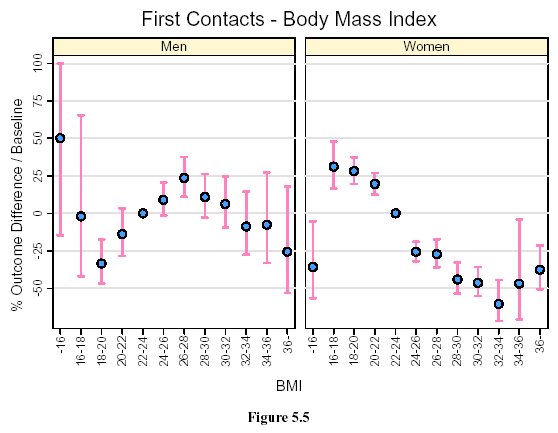
First, here's Hitsch et al.'s chart correlating body mass index (BMI) for men (left) and women (right) with response rate.

It's no surprise that women benefit more from being thinner, but I think it's really interesting that the response rate peaks at such an extremely low BMI. The authors report that the peak BMI is about 17, which corresponds to an underweight, "supermodel" figure. It is, of course, commonplace for feminists to remark that American society has unrealistically thin body expectations for women. A lot of men believe that this is an expectation perpetuated mostly by women's fashion magazines. Whenever you bring up the body image issue, online or off-, some man will say something like: "Well, I don't prefer stick-thin women. Slim, yes, but not bony like a fashion model." I mean, I'm a man who believes something like that. Yet I look at the chart above and I wonder.

Now, the caveats. First, it's possible that the results arise from men's misunderstanding how a numeric weight translates to an actual feminine figure. After all, the men are only reading a number, not looking at bodies (I'm assuming the profile photo's usually a head shot, rather than a full-length bikini beach photo). For example, I weigh about 155 lbs, and I assume that a slender woman my height would weigh somewhat less, but I'm not really sure whether 135 lbs would be emaciated or merely thin. Second, the economists find that women are probably lowballing their self-reported weight: "Among women, we find that the average stated weight is less than the average weight in the U.S. population. The discrepancy is about 6 lbs among 20-29 year olds, 18 lbs among 30-39 year olds, and 20 lbs among 40-49 year olds." --- so either the personals users are exceptionally fit, or they're lying. Men might know this, and compensate by mentally adding a few pounds to whatever the profile reads, hence their preference for exceptionally low (reported) BMI.

However, in spite of these caveats, I think the evidence suggests that the ideal towards which so many women strive is, to some extent, a rational judgment about men's aggregate weight preferences. It's true that people can be attracted to potential partners who don't attain that ideal. But that doesn't mean that more people wouldn't be more attracted, on average, to someone who's closer to that ideal.

OK, enough with the weight. Let's look at the ethnicity findings. In my opinion, these are the most interesting findings in the paper. Money, education, looks, weight, age? Everybody basically agrees and accepts that people discriminate based on these factors; they reflect differences in character, in lifestyle, or in plain sex appeal. But race and ethnicity are stickier issues. It's not clear whether it's really acceptable in polite society to admit that, given a choice between a good-looking white man and an equally good-looking black man, with the exact same job and income, you would really prefer to date the white man. Is that a form of racism, or not? Is that the same as men preferring blondes (an actual finding that, incidentally, also emerges in the study), or is it something different?

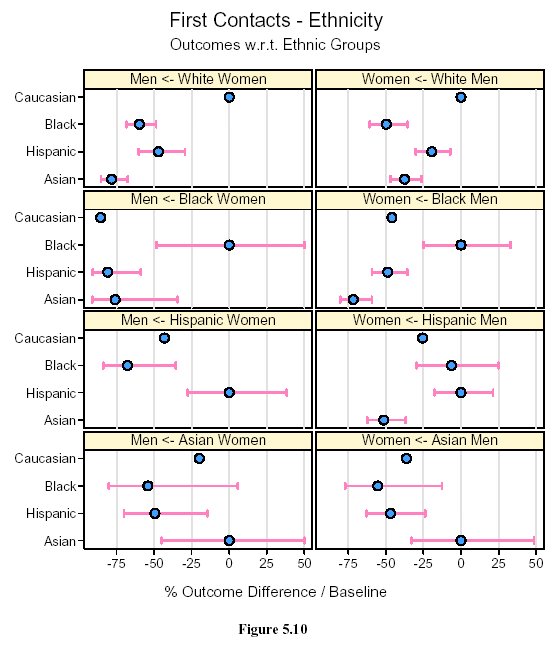
Anyway, here's Hitsch et al. 5-10:

This figure requires a bit of explanation. The charts on the left indicate who women emailed, and the charts on the right indicate who men emailed. These are so-called "first contact" emails, meaning that these are the preferences of initiators, not responders. (This is a pretty big source of asymmetry, since men are usually initiators. In fact, 54.5% of men received zero first contacts. For men, it would be more interesting to track "first responses" to emails sent.) The labels on the vertical axis indicate the ethnicity of the person emailed. For each of the four ethnicities --- white, black, Hispanic, and Asian --- the rate at which the emailer emails his/her own ethnicity is considered the baseline rate. The labels on the horizontal axis describe how much less (or more) probable each ethnicity is to receive a first contact email, compared to the baseline. (I assume the pink bars are confidence intervals.)

So, what's the result? All men and women of all ethnicities prefer their own ethnicity. That's straightforward enough and can be explained by basic homophily or whatever, although the strength of the preference is pretty startling to me: most groups have at least a roughly 1/4 disadvantage relative to baseline, and often more. I guess I'm naïve, but I would have hoped for closer to 5% than to 50%.

More interesting than the strength of the preference, however, are the differences among the groups. Some of the confidence intervals run pretty wide, so some individual charts have to be taken with a big grain of salt, but you can still see broad trends. For example, women across the board have much stronger ethnic preferences (or biases, if you like) than men. Also, Asian men and women alike seem to prefer whites significantly to any other non-Asian ethnic group, but whites do not return the preference, ranking Asians last or next-to-last. In fact, Asian men do pretty badly overall, coming in no better than a 75% diminished preference by any other ethnic group (and apparently getting zero emails from Hispanic women). Finally, based on my completely unscientific eyeballing of the charts, for whites and Asians, men and women seem to have preference profiles with similar "shapes" --- that is, the women's ethnic preferences are stronger, but their relative preferences are similar to men's --- but for blacks and Hispanics the men and women seem to diverge.

But even more interesting than any of that is Fig. 5-11:

This is the difference between (white) people who admit they have ethnic preferences, and those who claim that they don't. Note my verbs, because although there's a statistical difference, the curves have the same similar shapes (UPDATE: see comments), and the ethnic preference remains strong in the latter group --- greater than 50% for women, and in the ballpark of 15-50% for men.

I think that chart almost speaks for itself, so I'll keep my remarks brief. Is this caused by unconscious bias? Perhaps. Or maybe it's like lying about your weight. I know that if I saw that a woman's profile had an ethnic preference --- any preference, even for my own ethnicity --- I probably wouldn't want to email her. By not listing a preference, one signals one's open-mindedness.

Finally, to end on a lighter note, here's Fig. 5-7, the result that's probably most relevant to the people who read this blog --- educational attainment and response rates:

Look at the highest data point in first contacts for men. That's right guys, chicks dig grad students.

Well, OK, back to reality. Clearly, the "in post-graduate program" results for men are a fluke arising from the fact that the category lumps together professional students with Ph.D. grad students. Law, medicine, and business students are training for lucrative careers as highly esteemed members of society. Ph.D. grad students are training to be credentialed professional nerds. As much as I wish that most women found the latter attractive, I have to admit that it is, shall we say, a distinctly minority taste.

Tuesday, March 07, 2006

Peer review for your personality

A while ago, one of my friends (given how pissy and obnoxious I've been lately, I won't shame my friends by linking them here) linked to an online Johari Window app.

This meme's been making the rounds for a while, but most such apps have been limited by a lack of anonymity and excessive segregation of negative and positive traits. Recently, another acquaintance of mine whipped out his mad web hacking skills and threw together realpersonality.com, which seems clearly superior to the standard Johari apps if you're into that sort of thing.

Now, at this point I am put in a slightly awkward position, because truthfully I'm not all that curious what people think about me --- on the one hand, I think I have a pretty good handle on it, and on the other hand, I'm self-directed enough that I don't care that much. But, it's odd for me to recommend this to people if I don't use it myself. So, go to town if you like.

Incidentally, it's illuminating to consider the relationship between these apps and the likes of Hot or Not. The comparison suggests a couple of followup directions:

  • Add ratings of physical characteristics. (Duh.)

  • Bootstrap a dating service on top of the personality evaluator. Possibly mix in some kind of social networking/reputation system to reduce the risk of collusion attacks. This seems challenging, because there's an inherent tension between reputation systems and anonymity.

  • Conversely, add anonymous peer review to an existing matchmaking service. This would help solve an obvious problem with online socialization sites: you can put a profile on Friendster or Match.com or whatever, but the only feedback occurs when somebody's interested enough to send you a message, which is pretty coarse-grained and opaque. You have no idea what impression you're making on readers who don't contact you. You can ask friends to review your profile, but their reactions may differ radically from the reactions of people who don't already know you.

    Imagine a site where users could anonymously mark a profile with key adjectives, without actually contacting the person. One suspects that people would learn what works and doesn't work much more rapidly.

    It's interesting to speculate about the effects this would have. Would all profiles recede rapidly towards a mean of inoffensive blandness? Would people stay with the service longer, because they'd be getting better dates? Would they get alienated by the negative feedback and leave sooner? Or would they more rapidly meet the partner of their dreams, and leave sooner for that reason? In any case, while they're using the service, it seems likely that people would visit the site more frequently, because they'd be getting more frequent feedback --- which would be good for an ad-supported site, but bad for one supported only by user fees.

Monday, February 13, 2006

Random bitching about email software

Notice to all email software developers: one of the primary functions of email is to pass around URLs. You may not like it, but it's simply a fact of life. I'd guess that 90% of the email that I send or receive contains some form of URL, even if only in the sig. Therefore, any email client that "helpfully" word wraps URLs at 80 characters (or any other fixed width), when sending or forwarding or doing any other operation on email, is utterly broken. Designing email software with this misfeature is like designing a cell phone that sometimes randomly hangs up the phone when somebody says the word "hello". It's like designing an automobile that sometimes randomly stalls when it's at a red light that changes to green. It is, in short, completely absurd.

I use a mixture of Pine, KMail, and GMail for my email clients, and none of these has ever word-wrapped a URL on my behalf. Bless you, Pine/KMail/GMail developers. However, I still receive a fair amount of email, via mailing lists especially, that contains word wrapped URLs, and I am so freaking pissed at those anonymous software developers, somewhere out there, who are responsible for all the times that I have had to copy and paste bits of these URLs manually into a web browser. Come on! As Stephen Colbert would say, you're on notice.

Sunday, May 30, 2004

Social software in global cultures

Interesting post at Many to Many:

An interesting interview with Intel anthropologist Genevieve Bell challenges assumptions of technology in disparate cultures. “My hypothesis was that there was no variation, that there was a global middle class engaged in the same kinds of relationships with technology. It was a hypothesis that was rapidly disproved.” We have highlighted the use of social software to support third places, between work and home, by early adopters in the West, however:

One of the things that became clear in Asia, and is becoming true in the West, but we’re not really good at seeing it, is that people are using these technologies for those third activities. In Asia, it’s visible in the way people use mobile devices to support religious activities. The nicest example is people using their mobile phones to find Mecca. LGE, a Korean handset company, has produced a Mecca-finding handset with GPS technology in it. So it’s a tool of religious devotion. They anticipated selling 300 million units in the first couple years.

The world is turning into a Bruce Sterling novel.

Sunday, October 12, 2003

Cult of Shirky holds forth on future of file sharing

The latest NEC-list post discusses the probable future of file-sharing behavior. NEC (Networks, Economics, and Culture) is a low-traffic mailing list authored by Clay Shirky, who's something of a cult guru in new media circles. When I was an undergrad, I worked for a company that did an earlier iteration of his website; he was regarded by others with a curious reverence that nobody in our company could quite understand or justify. Anyway, he's interesting enough, and the list low-traffic enough, that you have no good reason not to subscribe to it.