For me, the hilarious thing about this is that somehow I didn't see it coming, and yet it seems so obvious in retrospect.
Showing posts with label grad-school. Show all posts
Showing posts with label grad-school. Show all posts
Tuesday, April 08, 2008
Thursday, January 26, 2006
Some scattered thoughts on interviews, Jorge Cham, computer science, and grad student hardship

So, I'm back from my first academic interview. Oddly enough, I had a great time. People tell me that this level of enjoyment fades after you've been to a dozen. Fortunately or unfortunately, I probably won't have that problem, because I probably won't have a dozen in-person interviews. I will also say that having a nice industry job offer in your back pocket makes these things much less stressful.
Which is all in the way of remarking that I saw Jorge Cham speak, not long ago, as part of his lecture tour on the travails of being a fledgling academic.
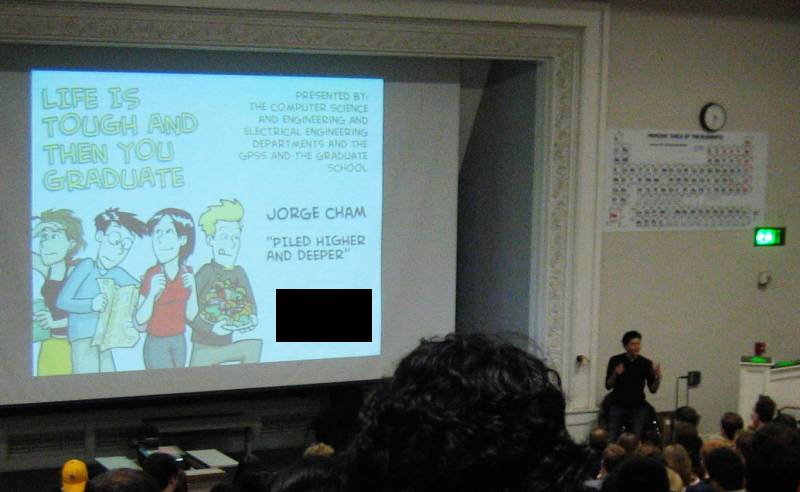
Jorge Cham --- or at least the lecture persona known as Jorge Cham --- is a brilliantly funny, smart, and compassionate guy, and I don't doubt that his strip and lecture tour are doing worlds of good for struggling grad students all over the country.
On the other hand, as a computer science grad student, I couldn't help but think: could it be possible that a grad student at Stanford computer science really had it that bad? In particular, Jorge's statements about the economic insecurity of grad students struck me as strange. Computer science is one of the few branches of academia for which the implicit bargain --- sacrifice now, and you'll get a good job later --- still holds. Now, that job may not be an academic job, but if you go to a good grad school in computer science and cannot land an academic job of some sort, then chances are that you weren't cut out for academia anyway.
Jorge --- like, for that matter, Cecilia and Nameless and Mike Slackenerny --- could get a very well-paying job in industry, at almost any time of his choosing, simply by walking away from the academic game. And this economic reality has consequences throughout the grad student experience --- at "good" schools (which certainly includes Stanford), we get paid a livable wage, and we're largely given the infrastructure we need to be productive, and we get decent support in our job search. Because we can walk away.
I understand that Jorge's speaking, in some sense, for all grad students, not just computer scientists. And I also understand that grad school poses emotional challenges that all the economic security in the world wouldn't fix. However, if I were in Jorge's place, I'd have confessed, in my lectures, that my deal was much sweeter than the average grad student's. I mean, I'd be slightly uneasy, coming from my current situation, laying claim to the full measure of grad student hardship.
Subscribe to:
Posts (Atom)